Recommended practice to understand three-dimensional objects
Added 2022-11-22 09:18:09 +0000 UTC
Recommended practice to understand three-dimensional objects
I've received a consultation from a follower about a problem, so I'm going to answer it!
I would like to give priority to Patreon supporters from now on, so if you have any questions or concerns, please fill out the form below!
https://forms.gle/zrKH8akgbWq2GvfV7
Q. When I try to copy a picture from a photograph or someone else's drawing, I cannot see it three-dimensionally and can only understand it superficially. Therefore, I am not able to draw pictures with angles, even atari (everything except the front, especially where the atari overlap, such as in a bent posture). What kind of practice is needed for me to be able to capture the three-dimensionality of a picture?
A. Know the shape of things, make use of auxiliary lines!
Thank you for your question.
When learning three-dimensional objects, copying is one of the fine ways to practice, isn't it? However, when you stop and wonder, "What is a three-dimensional object? please think a little about what you see and what you don't see!
-What's going on?" When you have the question, "What is it?", start by examining the materials and learning about their construction.
By looking, we get information about the form! But many people get confused just by looking...!
So, here I would like to talk about how to practice by using auxiliary lines.
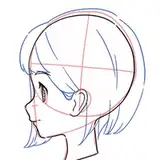
The method is quite simple. All you have to do is to put a pen on the image you want to refer to and draw a wire frame over the part you feel "difficult" or "unclear".
The wireframe here is a line that represents a three-dimensional object with overlapping vertical and horizontal lines, as seen in modeling.
Search Word:Modeling Wireframe
You don't need to draw in that much detail, so feel free to follow the shape of the unevenness carefully using straight lines and curves in a way that is easy for you to understand.

For the face, you can see which parts are aligned on which lines, and for the torso and limbs, you can see what shape of bulge and how they are connected, and whether the arc is agitated or overhead. It is also a good idea to use perspective lines to check the angles.
-If you think it might be difficult to add lines to an image of a person, try using images of fruits or small objects that are relatively simple in shape.
We recommend borrowing photos or images you have taken yourself to get as much information as possible from realistic objects, but you can also try using 3D models in some cases.
The quality of the latest Poser apps is very high, and I highly recommend it!
Sometimes you may want to take a break and look back on your illustrations and add auxiliary lines. It is also a good learning experience to borrow a favorite work of yours and trace out what you think you are missing, such as "what I wanted to do" or "what I wanted to attract the viewer"!
What is the use of drawing? You will learn the power of observation to know the shape of things!
To draw a three-dimensional object, it is very important to be aware of what you can see and what you cannot see. By improving the power of "observation" that everyone learns at an early age, you will be able to not only capture three-dimensional objects, but also to make your designs of characters, items, etc. more convincing.
In this issue, we talked about how to start by using auxiliary lines to understand shapes to address the concerns that "it is difficult to grasp three-dimensional objects" and "I don't know how to cultivate my eyes.
When you acquire the ability to observe, the way you see the world will change.
You will start to see things that you were not interested in before.
You begin to wonder what kind of structure this thing has, what kind of structure it is made of, and so on.
And as your understanding progresses, the world somehow seems to open up to you and you start to enjoy it!
I would be very happy if drawing becomes more positive in this way.
I hope you continue to have fun and improve your skills!