Vito's backstory part 3
Added 2024-08-01 10:44:40 +0000 UTCDoctor Laurentius, who was responsible for autopsies and disposing of the bodies, watched the vat of formaldehyde in the quiet of the laboratory. He thought about the boy he had once known and felt so very tired. Then Number 19 opened its eye, the one that had not originally belonged to him, and Laurentius realised it was still alive. To hell with the research group and Barros’s plans and Laurentius’s purpose. Overwhelmed by guilt and grief, the old doctor decided that if he could do anything to save the creature, he would. From the parts he cut away he made an imitation of the remains, shoved that in the vat of formaldehyde and packed the real body into a sack. And so, after the research group had burned the laboratories down to hide the evidence of their blasphemous deeds, Laurentius quit his job and retired to a remote island.
Goat Islands were where Laurentius had been born. They were a small cluster of mountainous islands, huddled together far from common trade routes. Their inhabitants consisted mostly of goats and their herders who thrived in the dry bushland surrounded by the cerulean sea. The Doctor had left the islands in his ambitious youth, excited to make a name for himself as a soldier. Now, years later, he returned home an old man burdened by the horrors of war. Once, Laurentius had resented the life of a simple goat herder, yet now he wished he had stayed where things were simpler and life was kinder, as it should have been for the boy with a bright smile and restless hands.
That boy, now a man, laid on the floor of Laurentius’ childhood home. Black stitches ran from his face all the way to his belly like a centipede and the fresh scars glinted a raw red in the lantern light. The Doctor had managed to give him his humanity back, at least in his appearance, although his right arm still bore that strange visage. Still, he showed no signs of malnourishment despite not eating properly for weeks - although his appearance was mostly human, he was not. Every morning, Laurentius cleaned his wounds and cursed and thanked the brutal experiment that had almost taken the man’s life and then saved it.
Even after regaining consciousness, the man’s recovery was slow and painful. However, it was greatly aided by the help of a goat (named Luigi) and nutritious fish soup. The patient spoke very little and always had a peculiar distant look in his eyes. Keeping busy did him good and so Laurentius let him help around the small farm. At first, all of the animals had been afraid of him (except for Luigi), but as he healed, they grew used to him. The islanders had been curious at first, but they left them alone when Laurentius said the man was his son, horribly wounded in a fire.
Whatever was left of Vidas was still there. Piece by piece, he remembered his past and his personality came back. He knew his name, although it made him nervous, so Laurentius called him Vito instead. Later, Vito started calling himself Faust after a mad scientist character he had read of as a child.
Soon came the day Laurentius had dreaded: Vito wanted to know about the project. And Laurentius told him. In the end, the young man did not learn much he didn’t already know. Only that the experiment required intelligent minds, and so animals could not be tested on. A silence fell, the kind that falls after bad news and horrible deeds. It was broken by the young man’s determined decision and the old man’s weary sigh. Vito wanted to find the research group, kill every last one of them and stop whatever the project was trying to accomplish. To do that, he needed to learn how to fight, and as a soldier, Laurentius could teach him that. It was then that Laurentius knew that Vidas could not be saved, not entirely - that gentle boy would have never spoken of murder with such hellish determination burning in his eyes.
Gentleness still lingered in Vito's hands when he took care of the animals. It showed in his gaze when he spoke of his siblings and his mother. Laurentius hoped it would be enough to keep him on a straight path. But Vito’s awkward smile changed into a relaxed grin and although he kept his almost childish attitude, his movements started to resemble a loaded gun. Perhaps he was not meant for paths that lead to peace and love anymore. This thought frightened the doctor.
It took Vito two years to fully heal. He spent his time herding goats and sparring with Laurentius. Perhaps it was Vito’s newly gained strength and determination, perhaps his new body adjusted easily - nevertheless, he learned the art of combat fast. Soon his impatient strikes had changed into calculated ones and his shoulders had grown wider than his master’s. He learned how to use most weapons, although he was very fond of Laurentius’ old musket. On sleepless nights he would study it, take it apart and put it back together over and over again. He knew he could not herd goats forever. He knew he had to leave, and he was restless.
Laurentius knew that restlessness, for he, too, had once been possessed by it, and knew he could never stop the young man. It wasn’t long until he was watching a small fishing vessel set out to sea. Vito had not taken much with him, only the necklace he had gotten from his mother, Laurentius’ old musket and enough money to last him a few days. Laurentius did not know when Vito would return, if ever, and admitting it was almost too much for the doctor. Especially when all of the girls in the harbour kept asking about the charming “son” of Laurentius.

The fishing vessel arrived at its destination after several days. The city of Teneba was located on an island named Southtoll that belonged to the Merchant Lords of Ambariya. Teneba was built between two forest-covered mountains, surrounded by turquoise sea and limestone cliffs that glistened white like whalebone. As the first Ambariyan port for many western merchants, it was a busy city. Vito felt terribly out of place. He was still far from his quarry with no idea how to find them - his mission started to seem more and more hopeless.
He did what any other person would have done in his situation: spent the next few months blackout drunk on the streets of Teneba. Nothing much happened during those months. At first, he stayed at a tavern because the owner’s daughter had taken a liking to him, but he was soon kicked out when the poor girl realised she deserved better. After that, he slept on the streets. Southtoll’s subtropical climate was very pleasant compared to what he was used to and besides, the drunkards, hobos and junkies left him alone when he threatened them with his musket or punched them in the face. He was tall and still knew how to fight (although he had put on some weight) and his overgrown hair and beard gave him the look of a madman.
The days started to resemble each other and Vito had little other concerns than to forget his misery. One of those days, when he was leaning against a lime tree in an alcohol-flavoured state somewhere between consciousness and unconsciousness, he had a thought. It was not a good thought nor a sane one, but it was certainly a thought. He could make a weapon. A very cool one at that. Perhaps he could use Laurentius’ (oh, Seas, the doctor would not approve of his current state) musket as a base. That was a goal he could achieve, right? If only he was sober enough to build anything more than a smelly bomb and had access to proper materials…
He cut his hair and trimmed his beard, cleaned and repaired his clothes, charmed a couple of wealthy ladies just to steal their money (yes, it was indeed a musket in his pants, now the cash please or he would shoot), and waltzed into an inventor’s shop he had seen in the harbour. It was run by one Eva-Marié Alvarez, an ifrit and an ex-pirate, who supplied trustworthy and less trustworthy ships with all sorts of cannons and catapults. Now, she was to become Vito’s involuntary acquaintance. She had agreed to let the man use her workshop in exchange for his help around her shop. She had not agreed to let him sleep in her workshop, too, but apparently the man was homeless despite his clean appearance.
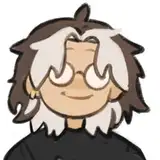
Vito Faust was terribly annoying, prone to accidents and in debt. But he was charming, handsome and his childish excitement was endearing. Not only that, he possessed a very kind heart under all his bravado, one he tried his best to hide well. And so Eva-Marié Alvarez, the self-proclaimed heartless gunsmith, became very fond of him. She thought the man shared her feelings, yet he never spoke of himself and never took off his glasses or the sleeve covering his right arm, not even when he was unclothed otherwise. She did not know him, and he would only hurt her.
It was not Vito’s intention. He, too, liked his acquaintance, but he was restless and knew he could not stay here. He could not play pretend when he knew he was not fully human and possibly dangerous. However, he needed to finish his gun, which was now so heavy it resembled an arquebus more than a musket. He stole the blueprints for Alvarez’s very special flintlock, wrote a delicate little note (“Oops, we’re over! Bye!”) and boarded the first ship that left Teneba. He never learned what happened to Miss Alvarez, but he’d rather not find out.

The ship arrived in the city of Cascada on Forge’s Island. It was close to Ambariya, but the city was known as the paradise for criminals and outcasts. Cascada’s few noble families wanted little to do with the people living outside their high walls unless it concerned merchandise or the chemical industry, and so the city could prosper in its unlawful glory. Despite the influence of many crime families, the colourful slums were home to many honest people. However, honest work was difficult to find: around the city the land was barren and brown and the waters of River Carro were foul downstream from the waterfall Cascada had been named after. Chemical waste and other impurities had done their job, aided by erosion and drought: Cascada was surrounded by a wasteland.
It was here that Vito Faust would set up his workshop. He borrowed money from one of the crime families, Momma’s boys, in exchange for his services, and bought an old shack. Soon, it became a busy shop (despite the fact that it was on fire more often than necessary). Vito still had a habit of drowning his sorrows in whiskey and absinthe and his list of pointless flings grew until he had the reputation of a heartbreaker. Still, he was more certain of his goal now and so his shop prospered. His criminal record was filled with petty crimes, such as “leading decent women into adultery, stealing, deceit, slander, possession of illegal goods, tax evasion and breach of the peace”, but despite the wanted posters nailed on the door of his shop, the inventor was under the protection of the gangs and the city did not care for such small misdeeds enough to oppose them. Very little was known about Vito Faust and many rumours went around (some of which were started by the man himself), but almost as many rumours of faraway lands made their way into his earshot.
Vito’s clientele was certainly colourful, but did not usually consist of children. He did make wonderful toys out of scrap metal, but most children feared him or their parents did not approve of his shop. Indeed, it came as a surprise when four children ran into his shop. Three of them were obviously older and chasing the one now hiding behind the Armour of Dishwashing. The infamous inventor took one good look at the bullies, then approached them and remarked they would be very useful for his new experiment. That was enough to send them running. He earned a grateful look from the young copper-haired boy. The boy, who introduced himself as Verneri, was most likely not local: he did not have the dark hair and skin of Ambariyans. In fact, he looked almost like an Ashlander like Vito, and the inventor was momentarily consumed by crippling homesickness and nostalgia.
He almost choked when Verneri requested to become his apprentice. Did the boy understand what he was asking the inventor and how truly unworthy he was for the role of a teacher? Of course he did not. To his and the boy’s surprise, Vito agreed. The conditions were simple: Verneri would work in Vito’s shop and in return, he would be fed and given a place to sleep. He would, however, have to address Vito as a professor, although the inventor lacked proof of any ties to any university. Verneri eagerly agreed.
He was a serious boy too smart for his age. He had grown up in an orphanage and had been given a basic education, however, he had left when the orphanage could not teach him any more. Verneri had deemed himself a grownup and despite being only eleven, he was more mature than his master in more ways than one. Vito was not the professor Verneri had hoped for: the man enjoyed many vices, forgot gunpowder near the fireplace, flirted with customers and would not clean up after his work exploded. Yet he was an excellent teacher and Verneri could see he truly cared for his student and his shop. Throughout the years, the inventor became something between an older brother, a father figure and a weird uncle to Verneri.
Verneri was not the only person who Vito grew fond of. Veronica was a member of Momma’s boys, the gang led by a large orc woman called Big Mama, and the one who dealt with Vito’s secret weapon supplies to the gang. They masked it under dates and flirts and Vito’s frequent visits to the brothel where Veronica worked, but truthfully, they were friends. The only one who knew Vito was not actually such a frequent brothel goer was Kaelo, a fortune teller who had their shop on the same street as V&V Inventions. Although they were not a real fortune teller, Kaelo was an odd individual and naturally, odd people gravitated towards each other. Vito and the pale foreigner became business partners: Vito supplied Kaelo with smoke machines and Kaelo told fortunes of wondrous solutions found across the street.
Out of Vito’s many flings, Verneri and Kaelo approved of only one. Vito had met her after one drunken night that ended with him passed out in a freshly dug grave. Olivia Merlo was a gravedigger working to earn herself enough money to attend school. Her reputation was that of a gruesome necromancer, although the girl was far from that: she was absent-minded and sweet, although somewhat of a fool. She dressed like a black mage (they were cute robes and she was broke, she even knitted a pink apron to contrast the black, why should she throw them away?) and she was accompanied by a horrifying undead shadow (it was her lovely friend). The shadow’s name was Veke and it was ultimately harmless, usually settling for helping Olivia with the dishes and making tea, but it possessed an eerily powerful aura.
Olivia was perhaps the only person Vito had loved since Callista. That scared him. His inhumaneness scared him even more, and he could not bear the shame that crippled him when Olivia saw his right eye. He became distant and irritable and eventually, ended things suddenly and bluntly. Even Olivia could not fix him and it was not her burden to do so. Olivia left Forge’s Island and Vito shut himself in his workshop. During those weeks he finished his weapon: the arquebus, named Catharsis, was now a fearsome weapon with enough firepower to punch through armour. Not only that, it could change into a polearm, a gruesome guisarme Vito handled with the relaxed ease of a trained soldier. The guisarme he named Corruption.
Vito ran his shop and waited for an opportunity to pursue his mission. His restlessness grew, but he knew he could not leave alone. Perhaps one day, the perfect opportunity would stumble into his shop in the form of an adventuring party…