So, I guess I'll be starting my series on musical advice with this! I figure the title "A Note on ____" works well, considering it's music! So, for my second-level backers, today I'll be teaching you a bit about harmonies! Some of you may already know I'm a bit of a self-proclaimed "sucker for harmonies". Alas, not all of you may be 100% sure of what a harmony is! I'm no Webster professor or anything like that, but I'll do my best to explain it in a way that makes sense without looking at a dictionary definition.
In music, a harmony is when two different notes are played at the same time to achieve a sort of combined note that sounds much more distinct and full than the two notes played on their own. That make sense? Basically, the simplest way I can think of to describe it is when you strum two different adjacent strings on a standard-tuned guitar. The notes are different, but they resonate together and sound nice.
When two or more notes are played together on a guitar at the same time, that is called a chord. A chord is a set of harmonic notes. The terms match up often. Try not to get too confused over it, I'll go into chords later.
Now, I'll also be the first to admit I'm not that knowledgeable on all the terminology used in music theory, but I do have a very good feel for what makes something sound good. Call it a natural affinity. In harmonies, what I would consider the most "pure" harmonies are major-key harmonies - as one example, ones that use every other white key on a piano.
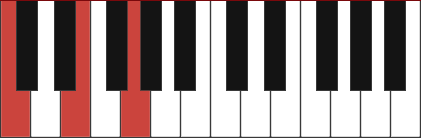
The chord above is C major. Just about everyone who hears this chord recognizes it, and it's kinda... plain. Pure. If we add one more note to it, it becomes C major seventh.
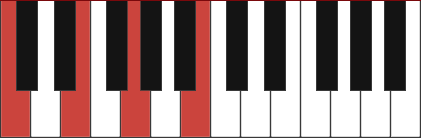
If I'm to be honest, what I feel from this chord is a playful sense of... "to be continued?" for lack of a better word. While in C major I feel a plain sense of childish simplicity, even adding one more note completely changes the feeling of the chord. This is the power of harmonies.
Harmonies can be used to convey emotion - progression, peace, chaos, hope, depression, finality, lack thereof - anything! Major chords and their associated harmonies tend to relate more towards happier feelings, lighthearted emotions and pleasant tones. Minor chords on the other hand, tend to evoke sadder or more depressing emotions.
Armed with that knowledge, let's take a set of chords that carry a sort of progression: A minor to start off with a sense of purpose for resolution, a major to feel slightly triumphant in progression, dropping a bit to another major to feel like you're still making progress, but it's slowing, and a minor once more to give the sense that there's more to be done.
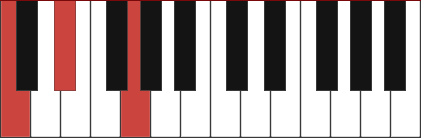
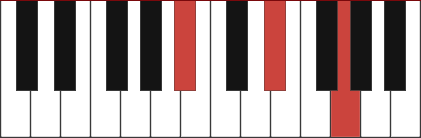
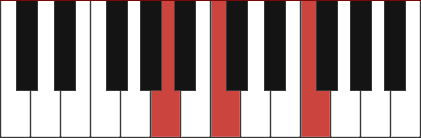
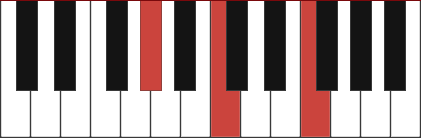
Looping those four chords, you can tell a story with notes alone... but me, no, I'm not happy until it's a beautiful shitpost. Click here to experience the revelation I had when I heard these chords in succession.
Don't worry, I'll wait while you listen to it.
All good? Good. I went off on a tangent there a moment, but do you see what I mean? Changing the chords alone, and in turn changing the harmonies heard, changed the entire feel of the song. I encourage you to experiment with creating your own harmonies and seeing what emotions they elicit in you. If you want, you can use this site to find out what the chord you're making is called, and leave a comment telling me what the chord is, and how it makes you feel.
As a closing thought, the piece I left at the top of this post was purely emotional. Having been attracted to harmonies my whole life, I was able to express the emotions I was feeling just by pitching my voice to the right combination of notes without any planning. If you take the time to master the emotion of harmony, you too can express yourself in this unique and creative way. I hope you enjoy what you've learned here, and thank you for being a wonderful patron!
(Also forgive me if the player at the top doesn't work right, I've been having problems with it the whole time while writing this. Downloads for both songs in this post are attached. Enjoy!)