1989 Ursula, a love story
Added 2023-05-30 14:39:03 +0000 UTCThis is not a critique, this is a dream. A dream that the body I saw Ursula in in Disney's The Little Mermaid (1989) at age 4 would be brought to life this past weekend in 2023. I knew it was a pipe dream. Melissa McCarthy is not the actor I would hire to proudly jiggle her fat on screen. She did her job. She was evil, leaned into her sexuality (a rare on screen occurrence for her), and stole Ariel's voice. But as I sat in the Staten Island Alamo Drafthouse Cinema, I found myself dreaming of that animated Ursula who gave me under the table permission to be the person I would one day become. I'm not talking about her lack of empathy or her manipulation, nor her innate need to steal the innocent souls of passersby, filling up her collectors bookshelf with their screams. I'm talking about something so much deeper.
Disney's 1989 Ursula was inspired by Divine. Muse of filmmaker John Waters, Divine was the queen of filth. She was quoted once saying, "I can stand on stage and do nothing, and people will write, 'Divine was outrageous.'” No question this is because of her fatness and unabashed queerness. She did not fight for assimilation, but to be seen, and seen she was. Divine passed away a year before The Little Mermaid (1989) was released, and was upon her death crowned "Drag Queen of the Century" by People Magazine. Her spirit lives on in 1989 Ursula. I wish that 2023 Ursula held her spirit, too. I wish that 2023 Ursula held out her hand to all of the fat queer kids who sat in theaters across the country this weekend, and whispered "You can take up space. Be queer. Be fat. Be whoever you are, unapologetically." I didn't feel it. Maybe it was the casting, maybe it was the costuming. Maybe Divine's spirit is just too big for any of us to capture today.
The choice to cover Ursula’s arms and back, corseted tight with a small waist and CGI enhanced breasts was obviously a shift from 1989 Ursula, and her divine inspiration. This is not to say I would have felt any differently had Melissa McCarthy been costumed differently — she’s a small fat, heterosexual woman (a different set of identities than what I would hope a casting of Ursula would hold). On identities alone — body alone — Melissa McCarthy can’t give me what I dreamed of for 2023 Ursula, and that’s not her fault, but Disney’s Ursula cannot be separated from the fat body and explicit queerness that carried her in 1989.
Gluttony, selfishness, ownership over others’ pain, and pride as a sin, in and of itself: Ursula's villainy is made up of these key attributes. Attributes that are often assigned to fatness and queerness. As queer folks we are accused of living in sin, our pride a part of that, gluttonous and selfish to engage in same-gender relationships, or gender transition because of the so-called harm it does to society. SCARY GAYS! LOVING EACH OTHER AND MINDING THEIR BUSINESS. Accused of promoting our deviant lifestyles. Similarly as fat people, we are all the same accused of promoting obesity, told we should not have pride over our fat bodies; we should cover up, hide, shrink ourselves. Regardless of our habits, assumed gluttonous, struggling with bingeing or addiction. Ursulas unapologetic existence alone is a carnal sin, as marked by the explicit displays of her fatness, and the vanity of her display. The vainness with which she experiences her super fatness. Fat rolls cascading down her back, her heavy stomach hanging over her FUPA, unrestricted in a strapless, backless gown.
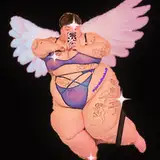
The only naked flesh we saw on Disney's 2023 Ursula were her breasts. As fat people, our breasts are not what deem us hyper-sexual. It's the roundness of our flesh, and the assumption that we indulge our bodies with whatever they desire (food, sex, sleep), while thin folks restrict. We are gluttonous, while thin people abstain -- or better yet, indulge, but only in moderation. Thin folks love to talk about moderation (or maybe that was just the lingo of the diet programs of the late 2000s and early 2010s that I endured). While we are hyper-sexualized, we are also seen as sexless, de-sexed by our own flesh. The larger the fat person, the harder it may be to immediately distinguish secondary sex characteristics. Larger fat folks across the sex spectrum have noticeable chest tissue/breasts, double chins possibly camouflaging an Adams apple, facial hair can be naturally occurring on anyone — the superfat body is a queer body. Queer, not in identity, but in perception. I regularly receive TikTok comments, “boy or girl?” “shave” “what is it?” “what is that thing?”. I imagine 1989 Ursula might have received the same commentary if she ended up on TikTok.
It's also important to acknowledge that the hyper-sexualization and simultaneous desexualization stems directly from anti-blackness, the root of fatphobia. As white fat folks, we experience the ripple effects of this, an echo, and it’s important to learn about and name where these experiences stem from. We are not the primary targets of anti-fatness. The anti-fatness we experience is to put us in our place under white supremacy, and in that we face harm, but that harm will never measure up to the harm fat Black folks face. To learn more about this I recommend reading “Belly of the Beast” by Da’Shaun Harrison, as well as the rest of their works (available through their website), “Girlhood Interrupted: The Erasure of Black Girls’ Childhood” by Rebecca Epstein, Jamilia J. Blake, and Thalia González, and Hortense Spillers’ 1987 essay “Mama's Baby, Papa's Maybe: An American Grammar Book.”
The cinching of the waist, the enhancement of the chest, the covering of the arms, these are all things that work to reinforce the gender conformity of 2023 Ursula. While they may be using drag makeup techniques, and doing interviews discussing Divine as the inspiration for Disney’s Ursula, I’m sad to say that 2023 comes up as a cheap impersonation of our filth queen, watered down and uninformed. In the middle of the Ozempic craze X trans genocide, I’m not shocked. I also don’t believe it was intentional. I think this is just what happens when you don’t prioritize authentic queer representation, as where Disney’s Ursula first began. And when it’s not animated, the fatness must be authentic too. So sorry.
You can't shortcut the beauty of a superfat body. You can add hundreds of feather light pounds to a person, piled up stuffing, silicone and latex. You can hire a makeup artist and make the skin corporeal. What you can't replicate is the bounce of Ursula's back-rolls as she whips her body around to cast a spell, her fat dancing with each body roll. You can't replicate the ripples of her skin, as she lunges forward, with a contract to steal Ariel's voice. More than anything, 2023 Ursula failed to replicate the butterflies I got as a child, seeing a fat, queer, six tentacled sea witch dance freely, bat winged arms and every fat roll proudly on display. It’s without these things, I lose Ursula. Or maybe she lost me. I don’t know. Either way, I will forever hold 1989 Ursula in my heart, who once let me in on a secret: screw how you’re perceived. Be who you are, freely, no matter what people say. Be fat. Be queer. Be loud. Be you.
“I only ask you for what is rightfully mine, what the good lord has bestowed on me: being divine!” — Divine in John Waters’s Mondo Trasho, 1969
Comments
I really enjoyed reading this! Thank you Jordan
Jackie
2023-05-31 04:15:02 +0000 UTCLove love loved this analysis, as always thank you Jordan
ECCElliott
2023-05-30 15:12:53 +0000 UTC