Genta Candidates, Part 2
Added 2024-02-06 20:18:28 +0000 UTCAfter a brief span in which we focused on the upcoming Spanish and Chinese translations of Golden Treasure: The Great Green, we are once again ready to unveil two new candidates for community-made minor species of Newhome. After meeting the polymorphic Fyrsa, the hunting Rofsa, and the silkweaving Chaka, today we will encounter the Rhusa and the Valsa. As always, we have attempted to keep the spirit of the original submission, though some details may have been altered to keep them in harmony with the greater setting and storyline.
Rhusa
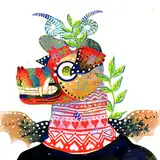
The Rhusa (so named for the purring, rolled-R “ru-ru-ru” sound they make when pleased) are scaly beings with six short yet powerful legs, measuring just over a meter long. Their overall figure might be compared to an elongated Earth gharial, with rounded black scales which shine blue in bright light. They communicate using complex patterns of clicks, growls, and whistles; a Rhusa conversation sounds like a blend of dolphin and crocodile sounds, which they can make without opening their mouths. Their eyes are mounted on tall head-crests, allowing them to see above the waterline when they submerge their bodies in their beloved hot springs, where they spend most of their lives. Natives of the volcanic island of Rhusalo, their history and life experience are shaped by the dance of heat and cold, which are central concepts in their history and philosophy.
In fact, the Rhusa have dozens of terms for “warm”, which is also associated with life, virtue, happiness, and harmony, and nearly as many for “cold”, which to the cold-blooded Rhusa is the ultimate enemy. Something being “warm” in their language is equivalent to the English “cool” (in the “good” sense, not the temperature sense), and something fiery and destructive, like a volcanic eruption, might be called “colder-than-ice” (that is, evil and disastrous). As they spend most of their time bathing, their skills in conversation, contemplation, mental games (which they tend to love) and poetry are well-developed.
Rhusalo’s location makes it naturally darker and cooler than most other places on the bright side of the planet. With the sun eternally sitting just beyond the horizon, it is eternally dusk (or dawn, if you prefer); some of the brighter stars are visible above, and the moons shine powerfully. As a counterpoint to this, Rhusalo is volcanically active, with bright magma ribbons cutting through the gloom in places. The volcanic activity has given rise to a multitude of natural hot springs which dot the landscape, and these pools are the basis of Rhusa society. Each of the larger pools is ruled by a dominant female who is the genetic base of each community as well as the ultimate authority; she alone can allow new members and banish current members. A Rhusa which does not receive warmth from an outside source for over 1 pul will fall into torpor and eventually die, so community membership is a matter of life and death.
The reigning Matriarch or “pool-mistress” of a Rhusa community creates offspring by laying eggs into the ruby-colored throat pouch of a male in a fashion similar to Earth seahorses. The male then incubates the pouched eggs by using his breath and heat from the hot springs to regulate temperature. When the eggs hatch, the male raises the young, allowing the Matriarch to concentrate on more important temporal matters. The Matriarch will usually have a large harem of males to fertilize her and raise her young, chosen for their physical appearance and their docile nature; as a result, Rhusa males are encouraged to be gentle, compassionate, obedient, and nurturing, while females, who are genetically expendable and often competing to be the next Matriarch, are taught to be aggressive, self-confident, and risk-taking. The number of viable hot springs are limited and Rhusa reproduction is bound to them, so competition is very fierce among the females, and the method by which one becomes a Matriarch is of very great concern to the Rhusa. Some Matriarchs rise to their position by being bold explorers and warriors, while others scheme or even assassinate their way into the position, though this must be done very cleverly, as anyone known to have physically harmed a Matriarch will usually be frozen to death. In the distant past, new Matriarchs were chosen through combat, but as their society evolved, most communities have abandoned this in favor of other less dangerous methods ranging from female primogeniture to popular vote.
Some thousands of years ago, the Rhusa found a natural ally in the enormous Hubum species. These warm-skinned, furry grazers can be ridden by several Rhusa at once and provide a means of safe travel beyond the hot springs. One nomadic Rhusa tribe has even adapted to living more or less their entire lives on the backs of these creatures, though reproduction without the hot springs is difficult. The Hubum are well cared for, but are not allowed to enter hot springs or structures.
As one of the few genta species which can see the stars, the Rhusa have long had a fascination with light, and are skilled in building fires, which they use both for warmth and for long-distance communication. They worship gods which are traditionally portrayed as butterfly-winged serpents and bear a passing resemblance to the Draak-Kin; they believe the moons to be their eggs, and await their hatching, which is believed to usher in a new age of peace and warmth.
Though some other genta species dismiss the Rhusa as inconsequential stargazers, these bathing saurians are far more intelligent than most believe. Their natural competition for the highly-valued position of Matriarch has made their females excellent warriors both physically and socially, and Rhusa manipulation of others can sometimes be so powerful and so complex that even the Luxa are amazed at the depth their conflicts and schemes can sometimes reach. They tend to beat other gentas, including the Draak, at games of strategy, and a Luxa research team recently issued a report stating that the Rhusa might be considered a Class One threat to global stability were they not bound to the hot springs of Rhusalo. The explosive economic success of the one expatriate Rhusa community in Carnivalia has given credence to this. Though most Rhusa live normal lives, applying their powerful minds to no more than keeping well-fed and reasonably happy, a cruel or ambitious Rhusa might cause considerable chaos without anyone even knowing they were doing so.
Valsa (Valys)
Known internationally as the Valsa, the people who call themselves the Valys, or “Renewers”, are quadrupedal carnivores native to Valsalo. A small species, they are about half the height of a Kaga and roughly the same mass as a Coba. However, they appear larger and bulkier due to their very long, thick fur and the fan-like collar protrusion which they can flare up or flatten down, similar to a frilled lizard. Their legs and tail are strong and of short to medium length. They possess four long fangs and naturally venomous saliva, and are skilled chase and ambush hunters whose prey experiences a powerful euphoria when envenomed, dying strangely happy as they are ripped apart and consumed. Like most Earth quadrupeds, they cannot comfortably stand on their back legs alone, and their limbs end in three flexible but unopposable taloned digits. Their fur is grey, turning to silver with age, though their neck frills can be any color.
The powerful hemotoxin/neurotoxin cocktail contained in their saliva allows them to hunt creatures larger than themselves, and they have mastered a dance-like style of combat combining surprise, evasion, speed, and a single, fateful bite when fighting beings the same size or larger than themselves. Smaller prey can simply be run down. Though they tend to hunt alone, they live in a single unified community, and large prey is willingly shared with others. Generosity and friendship are considered cardinal virtues, and despite being feared assassins of wildlife, they are quite gentle and kind when among their own. Grooming and cuddling are raised to art forms in their community, everyone knows everyone else’s personality, hopes, and dreams, and most would willingly put themselves in danger for the sake of any other Valsa.
In stark contrast to this deep kindness and friendliness, the Valsa reproductive cycle contains a ruthless element. Once every 30 years, the community enters its “Time of Creation”. This begins with several puls of an ongoing gentle and loving species-wide orgy. When this concludes, just before the eggs are laid (Valsa are oviparous), all Valsa 90 years of age or older are killed and eaten by the commune. They call this “The Exchange”, as old is traded for new, and death is given for life. As a result, the Valsa community consists of three generations exactly 30 years apart in age, amounting to a total renewal of their entire population every 90 years. The names of these three groups can be roughly translated to “Future” (the youngest), “Present”, and “Past”, though they are all regarded as fundamentally equal to each other and worthy of respect and love.
The Luxa research team which discovered the Valsa happened to encounter them during a generational slaughter. They were horrified, and recognition of the Valsa as a genta species was slow and difficult, occurring only when a captive Valsa took it upon itself to stealthily learn the Luxa language and represent it visually using claw marks in sand in an attempt to communicate. Their own language is just as nuanced and complex as any other, though its disharmonic tones and clicks are not considered beautiful by most other species.
Today, though they have been acknowledged as gentas by the broader global community, the Valsa are looked down upon by many. Having little interest in technology, artifacts, or self-decoration (with the notable exception of crest-dyeing, which the Valsa enjoy very greatly) and lacking opposable digits, they are seen as barbaric. Their ritual cannibalism is, in fact, quite beneficial, both in maintaining population control and preventing the horrible decline into madness which accompanies very old age in the species. This “planned death” custom also encourages acceptance of one’s own mortality and a more selfless, community-oriented long-term view. Still, tearing apart and eating one’s own grandparents as a matter of course runs counter to most genta systems of morality. The future of this savage yet loving species is unclear; their unified culture would make it quite easy for a Draak-Kin to establish itself as Hierophant over the race, but these kindly killers are wise, and cannot be easily tempted or coerced into any particular action outside of their own well-established way of life.
___
Look forward to meeting more potential cultures and civilizations as February rolls on!
-L
Comments
So happy to hear! We try quite hard to honor the original in these.
Benjamin Ludwig
2024-02-07 15:45:03 +0000 UTCI love everything that was added to the Rhusa, you did a great job of fleshing out their culture from the original entry.
MintMist
2024-02-06 23:59:25 +0000 UTC