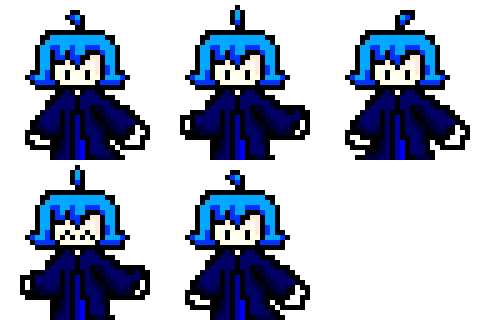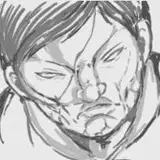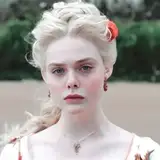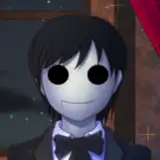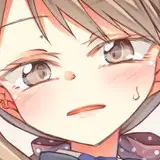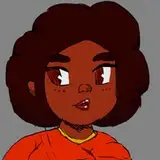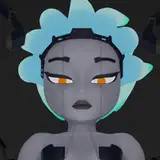
It's funny. My notes were a single sticky note stuck to the side of my monitor with the names of the three Precursor races on it. My grand-daughter drew on it and I like that note better. Now my notes consist of the stuff I have previously written.
This story has gone in strange directions, but always toward the end of the story. The "Humanity Fuck Yeah" is both to inspire awe and show that we can always strive to be better. While we can never be perfect, there is always some room, somewhere, for self-improvement. (I, for example, really should stop smoking and guzzling energy drinks)
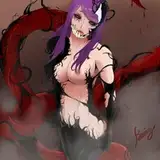
But the last few chapters. Taking the demonic character of Dee Tanynee as she grew in the Nightmare Chapters of Darkside Station into the Lady of Hell, was a hell of ride.
See, everyone wants to be liked. Even authors. We worry that people will be turned off by a character. Nowadays it's even more stressful.
Why? Well, I've long noticed a trend in fiction that the bad guys can't be too bad. That their motives must be relatable, that they all have redemption arcs, that they all be someone you, as the reader, can pity. That villains are less villains than victims lashing out at society.
Dee is not that kind of villain.
She brings up fear, disgust, and an odd attraction. She's alluring in a dark way that you don't want to admit, which causes further revulsion. She's a difficult character to write, a hard character to read about, and even harder to empathize with. I hear, all the time, 'the reader should be able to empathize with the villain' and shake my head. I didn't empathize with Sauron or any of the other bad guys of fiction gone by.
But then, I grew up on Mike Hammer, Mack Bolan, Remo Williams, Frodo, the Lion, the Witch, and the Wardrobe, Ringworld, and stuff like that.
I made Dee a collection of sins of the past. Her sum total is nothing more than mankinds sins, wrapped up in one package. She embodies or has witnessed the worst that humanity has to offer. She drops hints of her half remembered past in a way that is obvious she holds no pity or sadness for it.
And it makes her hard to write, maybe harder to read.
But even the Devil serves a purpose.
In some ways I'm glad I'm past this part. It's difficult, exhausting to write.
But you know, the fact she evokes such strong emotions in you guys means I'm doing it write. This wasn't a hero I wanted everyone to love. She invokes strong emotions, which, in these uncertain times where you aren't even sure if you are allowed to feel, much less understand or know how you should feel, is a good thing.
The lockdowns have been tough. We miss each other. We miss outside. We miss the little things we took for granted. The masks make it so one of the most important parts of our recognition of one another are covered up, further separating us from our fellow man, which has, at least in my case at times, left us strangely lonely in a way we can barely comprehend or sometimes even be aware of.
Someone like Dee, Sam, and Herod, make us feel emotions on the behalf of someone else. It doesn't matter that they're fictional. In some ways, due to the masks, the lockdowns, the social distancing, they're closer to us than real people.
And that hurts me in some strange way.
I think next I'll meet up with some old friends.
And finally, on a final thought, bear with me:
When I was younger, back in the bad old days of rabbit ear antenna and cable being for rich people who lived in the city, I saw a TV show. I missed the intro flipping through the channels and then using the dial behind the channel selector to fine tune in the channel.
But a guy had been convicted of a crime. They put a mark on his forehead and everyone shunned him, acted as if he didn't exist. It was the harshest penalty they could give: A year. At first he had a great time. Then it started to set in. People didn't see him, didn't react to him, pretended he wasn't there.
At one point he was begging people to just look at him. Toward the end of his sentence he screamed, raved, cried, threw himself against the walls. Even contemplated suicide.
When the cops came in and removed the mark, he wept before they even removed it. Because they touched him, said his name, acknowledged he was there.
The scene changed and he was standing in line. A woman came up with the same marking, begging, pleading for anyone to see her, to admit she was real, to see her.
Moved by her plight, something he himself had been subjected to, he embraced her. Held her tight, even as the law enforcement drones flew in and told him he was in violation of the law, that he would be subject to penalties.
They held each other and cried.
He had learned his lesson. Had learned to value others.
Now, we see our world, our lives. Six feet of distance. Their faces covered so it removes part of our hard wired ability to see someone as people. No face to face meetings. Moving through our own bubbles, barely acknowledging one another.
Last week, in Wal-Mart, I saw someone break down, start crying. Just quietly. When I asked if she was all right, she nodded and just told me she had suddenly realized how lonely she was when someone said "excuse me" to get by her.
Old sci-fi writers, hell, psychologists not long ago, considered isolation the worst thing that could happen to a person. As little as two years ago the arguments against solitary confinement stated outright that isolation drives people mad.
And look where we are.
So, if you wonder why I took the time to write someone like Dee, why I keep writing and writing and writing, and hope you can connect with the characters, now you know.
I don't want you to be lonely, if you are one of the people trapped in apartment or house by yourself.
I hope I can make quarantine a little more bearable.
I've wanted that from the start.
And so, here we are, on the shining edge of tomorrow, unsure whether the brightness is the cutting edge of a razor blade or the coming of a new dawn.
--Ralts Bloodthorne
(Artwork by Ronald Fong)