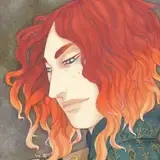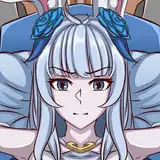
Across from her at the table is Lexa, who is also gazing into the distance.
“Carida…”
Lexa has been like this since the date happened last Friday. She’s been sketching drafts for picture books, but mostly just drawing variations of a dog character. Cherry gets the feeling this particular design is inspired by Carida, Lexa’s date. She wonders how the date went.
Maybe it’s fine to ask her?
But what if the words come out wrong?
But her curiosity propels her to blurt out the words, “How is date?”
“Marvelous! Fantastic! Literary!” Lexa stands up, shocking everyone around her. The library’s stillness crashes as Lexa’s chair topples. “This is the ultimate love. The ultimate passion!”
Cherry hides her face behind a grammar book. Everyone is staring at them now. This is way too embarrassing.
Lexa twirls over to the reference section and picks out another grammar book for Cherry. Everyone around her is frozen in horror and disbelief that the infamous Beast of the Library, the very same who leers at people for being too noisy, is now humming a joyful tune.
“Let’s work on your grammar together, shall we?” says Lexa, placing the book onto the table.
Cherry nods.

Mima bought a book on the history of Yayue from the bookstore near her cafe. The book is titled The Land of the Dragons: A History of Yayue and it’s written by Elly Han. The publisher is the University of Rococo, which explains the hefty price tag. This was the only book on Yayue on the shelves and Mima, remembering her university days, has retained a certain trust in university presses. Hopefully this kind of publisher could present accurate information over most others. Mima decides that she’ll read the book back in the cafe, assuming that her few customers won’t mind.
It’s not like there’s much to do anyway…
She flips through the first few pages of the book. Mima sees the name of Yayue in its proper form for the first time: 雅樂. The first character symbolizes elegance while the second character is the word for music. In essence, the two Yayue characters put together read as elegant music.
Mima thinks of how elegant Cherry looked the day she kissed her.
She reads further into the introduction. After the author introduces herself as a Yayue expat, the text briefly discusses the particular creation myth that has developed around Yayue. According to legend, the many deities in the celestial heavens wanted a new world for their children to grow up in. The skies were limitless and the children could wander too far away with ease, never to be seen again. A new world — this earth — would stop them from leaving their parents again. The earth was made of ice and lava from the eternal wellspring, with their fusion melting into the earth everyone knows today. This is part of why Yayue citizens see themselves as children of the deities.
Of course, the actual story of the founding of Yayue is a much more banal matter. But there’s a good deal of political intrigue present in learning about how the dynastic empires rose into and fell out of power. It’s quite like reading a political thriller novel.
Mima remembers from previous chats on Wondr that Cherry and her family live in the outskirts of Yayue. That might mean that they, like many Yayue people, would’ve never seen the imperial history she’s been reading about themselves. The chapters most likely to pertain to Cherry are probably the ones on rural life. They depict a quaint, somber life. Picturesque and idyllic as it might be, life on the outskirts is tough even in modern times. The roads are paved poorly and the buildings aren’t constructed from good materials either. Money rarely comes to the rural areas and the young move to the cities for the promise of work and luxury. Yet, life goes on. These rural areas might as well be called villages because such a communitarian spirit exists within everybody.
As Mima reads on, the chapters on the language of Yayue interest her particularly. As Han suggests, it may be more appropriate to think of the Yayue language as a “language of languages”. The written components of the language were constructed before the oral components, the complete reverse of Canticle-based languages like Celestian. Therefore, the characters can be pronounced differently in other Yayue regions but have roughly the same meaning regardless. More interestingly, these characters are called ideographs because they represent “ideas” (ideo) in a “gram” (the way something is written, like alphabets or grammar). For example, Mima can squint and see that the Yayue character for people is a person on their two feet. Most characters' pictorial meanings are however lost to time and many Yayue loanwords use characters to signify the phonetic readings. Mima’s somewhat amused that coffee is rendered as cafei. This is why people learning the Yayue language apparently should not put too much stock into the meanings of individual characters. It’s better to learn words and then learn what the characters mean instead of doing things the other way around.
I wonder what Cherry’s actual name is.
Mima wonders if there is anything special about her Yayue name. She’s seen names that hearken back to themes of greatness and nature. Does Cherry have a name like that? Or is it something plainer and yet beautiful in its own way?
There’s so much to learn about Cherry and the place she came from. She wonders how long Cherry will stay on the island. It worries her that she may leave before Mima really gets to know her.
But what’s the point of worrying about that?
Mima gets to appreciate the present. The time she spends with Cherry now is what matters, not the vague and scary future.
She reads through the book, appreciating the context Cherry comes from. Her imagination lets her soar into the past and present, the events and circumstances that may have helped define who Cherry is. A regular customer walks in and she closes the book with a “Hello, do you want the regular chocolate latte again?”
“The Celestian language originally came from a bigger language, Canticle. Canticle was the language many people spoke back then, but it became fragmented into smaller languages. Canticle came to the islands through trade and mixed with other languages from here, becoming what we call Celestian today.”
Lexa is lecturing Cherry on the roots of Celestian to give her a more historical context of the language she’s trying to learn. She has a portable whiteboard behind her and is scribbling big letters like “Canticle”. It seems that Lexa believes that the linguistic history could humanize the language a bit more, which Cherry can appreciate.
“Yayue is also language that is big, but people say Yayue very differently,” Cherry says. “Almost like different languages.”
“Mhmm. Some people do speak Canticle too, but they are speaking a more modern form. The actual archaic Canticle is lost to time, but languages evolve. That’s what happened with Celestian too.” Lexa goes back and writes on the whiteboard “Celestian” and then connects it to “Canticle” with a straight line. “You often see grammar rules from Canticle mixing in with the rules of other indigenous languages here.”
“Indigenous languages?”
“Native languages. You sometimes hear the elderly here use old words you’ve never heard of. That’s where those words come from.”
Cherry thinks about this. When she left Mima’s cafe, an old man was singing on the streets with a microphone attached to an amp. He was not a particularly good singer, but he often sang with passion. Sometimes he sang modern songs that Cherry knew from watching movies, but he also sang some old songs with words she didn’t know.
“That’s why Celestian can look a bit complicated to outsiders, I bet. Archaic Canticle rules mixing in with the indigenous languages here.” Lexa draws a circle, writes “indigenous languages” in it and connects it to “Celestian”. “But you know, it’s actually a neat language because it respects all types of old languages and doesn’t really cede to one over the other. I think that’s why you have so many linguists studying our peculiar language here.”
Lexa picks up the grammar book and flips to a particular page.
“But then,” she says, “there’s weird grammar constructions like this: the difference between ‘a’ and ‘the’.” She draws the words “a” and “the” in beneath “Celestian”.
“I confused by them,” Cherry says as she blushes. “What is difference between ‘a book’ and ‘the book’?”
“Let’s see here, the grammar book says: ‘The difference between the articles ‘a’ and ‘the’ is that the former is more broad and vague while the latter denotes a specificity.’ Basically, ‘a book’ would just mean any kind of book while ‘the book’ would refer to something with specific characteristics.”
“So I say, ‘I buy the book’, to bookstore owner?”
Lexa lets out a small laugh. “No, it’s not like that. You say you are buying a book, not the book in that situation. It depends on context. Sometimes, the rules you read in those grammar books don’t match up entirely with the context you're in. You’ll need to get used to contexts — exceptions to those rules in specific circumstances, I guess.”
“Context…”
“Celestian is difficult, isn’t it?”
Cherry puts down the pen. Jotting things down has become too tiring. She stretches her arms before saying “yes”.
“Mind me looking at your notes?”
Cherry nods and Lexa walks over to pick up her book.
“Your writing is so pretty and neat.” Lexa looks back at her handwriting, which is more cursive than Cherry’s straightforward writing. “Mine’s much messier.”
“I think yours is pretty too!”
“Gee, thanks…” Lexa’s cheeks redden as she flips through the notes. “This is so super detailed. It’s like you just transcribed the whole lecture and then translated it into Yayue. I’m impressed.”
“It is only way I understand. I do not know how to take shortcuts.”
“That said, you seem to be switching tenses a lot.”
“Oh?
“Random example: The professor included the Attunement Photography as example of Visual Arts Attunement and says that they can make photos more vibrant and colorful. ‘Included’ is in past tense while ‘says’ is in present.”
“I know tenses, but do not know the difference. In Yayue, tenses do not exist.”
“Huh.” Lexa says as she closes Cherry’s notebook and hands it back to her. “Didn’t know that.”
“Yayue indicates pastness through a word, ye. That is it.”
“No future tense either? Like will and would?”
“No. Yayue speaks as if we are doing it now and then.”
Lexa goes back to the whiteboard and says, “That’s interesting. Goes to show that we still have a ton to learn.”
Cherry looks down at her notebook. “I wish I learn everything. There are so many things in world that I want to know.”
“It’s the same with me, you know.” Lexa looks back at the whiteboard. “I think we all want to know everything in the world, but that’s impossible.”
“Why?”
“Well, for example… Even if you learn all the advanced forms of Celestian, there will still be mysteries in the language. Languages evolve and adopt new forms, new vocabularies, new things to describe new situations. Change is inevitable.”
“I don’t like that.”
“That’s fine. Me neither.” Lexa turns back to Cherry. “Look around us: this library is filled with so many books detailing different subjects and themes. We aren’t going to be able to read all of the books in this library — and there’s other libraries in Cadence City and even elsewhere! Not to mention that more books are being written everyday too. I would love to know everything and that’s why I read, but I know it’s impossible really.”
“I think it is sad.”
“It is, but that’s how expansive the world — no, the universe is! You’ve heard of the Attunement Scientist, Izuhara Miki, right? She said that our universe is expanding and that means more and more things are created everyday. While our rate of knowledge is expanding, so are the unknowns in the universe too. We can’t possibly know everything. It’s like this whiteboard.” Lexa points back to it. “The text on the whiteboard symbolizes what we know about the universe, but then there is the white space in the corner. That’s the unknown. The moment we fill up that remaining space and figure that out, a new unknown space appears. And then another and another.”
“Hmm, so it is like we learn Celestian but cannot catch up to everything it will create later.”
“Yes,” Lexa says, excited that her student is getting her librarian philosophy towards life. “No matter how we chase it, that white space will never be covered up.”
Cherry is reminded of legends and fables of Yayue people chasing after the sun, yet forever unable to reach it. The sun always looks like it can be reached by foot, but people can’t ever meet with it. The moral of the fable is something like There will always be limits to everything we do.
“While that means we can’t ever attain full knowledge of everything, we can appreciate that white space. It’s there and is receding into the distance, but that makes us want to chase it — to learn everything we can and strive for that. That’s what all scholars want to do.”
Cherry watches as Lexa looks wistfully at the empty space of the whiteboard.
She’s finished closing up shop and her thoughts are once again of Cherry and Yayue. Mima sits on her bed and takes out her phone. The second she clicks on the Wondr app, a message from Cherry pops up.
Cherry: Hello :)
Cherry: Are you busy??
Ah, Cherry’s so cute…
Mima: No, I’m very much free!
Cherry: Yay!
Cherry: I was studying Celestian with Lexa. Celestian is hard!
Mima: It must be.
Cherry: I do not understand difference between present and past tense.
Cherry: Very weird!
Mima: I read a book on Yayue today actually. It says the language doesn’t distinguish tenses.
Cherry: Yes! You read book on Yayue??
Mima: Yeah, I got … curious.
Mima: It’s in Celestian though.
Cherry: That is wonderful!
The conversation has naturally turned towards language. Maybe this is the perfect time to ask her the question. Mima swallows and tells herself, Here we go!
Mima: Do you have a Yayue name?
Cherry stops typing. Seconds pass by. Then, minutes. Has Mima touched a nerve by asking a question that might’ve been too delicate and sensitive?
She sees Cherry is typing… and instead of feeling relief, she’s now become anxious. What is Cherry going to type?
Cherry: Huiyin!
Cherry: Sorry, Lexa starts singing about her date again. It was very noisy!
Cherry: I tell her to be quiet!!
Mima stuffs her head into her pillow. Why did she even think she could annoy Cherry by asking such an innocent question?
Maybe I’m becoming too attached to Cherry.
She rolls over and looks at the new messages sent by Cherry.
Cherry: Huiyin is tough to say. Lexa has difficulty saying it.
Cherry: That is why I do not mind people saying Cherry!
This seems a bit unfair to Mima. Just because people here can’t pronounce her name doesn’t mean she should have to give it up.
Mima: What does your name mean?
Cherry: Mm, it does not mean anything.
Cherry: But my parents say they name me after the first Yayue ice skater.
Cherry: In Yayue, there is no place to skate ice! Yet, Yayue people want to compete in ice skating competition at international sports event. Zheng Huiyin moves to place with ice and learns to ice skate.
Cherry: She wins gold and makes Yayue proud. My parents name me after her. I am Li Huiyin!
Mima types out “That’s a beautiful story” before sniffling a bit. The parallels between the two Huiyins are too remarkable: two people in foreign territories bringing new hope back to their communities. Cherry — no, Huiyin doesn’t seem to realize how similar she is to the figure she’s named after.
I want to tell her she is special.
Mima: Can I call you Huiyin?
Cherry: Okay, but hard name to say!
Mima: That’s fine. I will learn to say it.
Cherry: But I like Cherry too.
Mima: It’s a nice name, but Huiyin is prettier.
Cherry: Mm, that’s embarrassing...
Mima smiles. Huiyin isn’t a name she’s used to, but it will be worth the effort.
She hears the cat meow from behind the ajar door. They like to do that to let Mima know they want to sleep beside her.
“Come on over,” Mima says, “let’s dream of sweet things together.”
The cat pushes the door open and leaps into Mima’s lap.
Life is wonderful, even if it is tiring. Lexa teaches me Celestian grammar and even some history behind it. Then, Mima says she reads book on Yayue and wants to call me Huiyin! It is nice but a bit embarrassing!
I still feel bit lonely though. Yayue is so far away. I miss it. Wonder what Father and Mother are doing. Is Uncle and Auntie happy? The letters from them should come in few days, but they are so far.
I should try not be lonely. I only have one year here. I must study and work hard and make everyone proud. I will have good Celestian and good skills!

Previous Chapter | Index | Next Chapter
Stuart Telfer
2021-02-17 03:38:50 +0000 UTC