[This is a transcript of the video.]
I need a new car, and in my case “new” really means “used”. I can’t afford one of the shiny new electric ones, so it’s either gasoline or diesel. But in recent years we’ve seen a lot of bad headlines about diesel. Why do diesel engines have such a bad reputation? How much does diesel exhaust affect our health really? And what’s the car industry doing about it? That’s what we will talk about today.
In September 2015, news broke about the Volkswagen emissions scandal, sometimes referred to as Dieselgate. It turned out Volkswagen had equipped cars with a special setting for emission tests, so that they would create less pollution during the test than on the road. Much of the world seems to have been shocked how the allegedly accurate and efficient Germans could possibly have done such a thing. I wasn’t really surprised. Let me tell you why.
My first car was a little red ford fiesta near the end of its life. For the emissions test I used to take it to a cheap repair shop in the outskirts of a suburb of a suburb. There was no train station and really nothing else nearby, so I’d usually just wait there. One day I saw the guy from the shop fumbling around on the engine before the emissions test and asked him what he was doing. Oh, he said, he’s just turning down the engine so it’ll pass the test. But with that setting the car wouldn’t properly drive, so later he’ll turn it up again.
Well, I thought, that probably wasn’t the point of the emissions test. But I didn’t have money for a better car. When I heard the news about the Volkswagen scandal, that made total sense to me. Of course the always efficient Germans would eventually automatize this little extra setting for the emissions test.
But why is diesel in particular so controversial? Diesel and gasoline engines are similar in that they’re both internal combustion engines. In these engines, fuel is ignited which moves a piston, so it converts chemical energy into mechanical energy.
The major difference between diesel and gasoline is the way these explosions happen. In a gasoline engine, the fuel is mixed with air, compressed by pistons and ignited by sparks from spark plugs. In a diesel engine, the air is compressed first which heats it up. Then the fuel is injected into the hot air and ignites.
One advantage of diesel engines is that they don’t need a constant ignition spark. You just have to get them going once and then they’ll keep on running. Another advantage is that the energy efficiency is about thirty percent higher than that of gasoline engines. They also have lower carbon dioxide emissions per kilometer. For this reason, they were long considered environmentally preferable.
The disadvantage of diesel engines is that the hotter and more compressed gas produces more nitrous oxide and more particulates. And those are a health hazard.
Nitrous Oxides are combinations of one Nitrogen and one or several Oxygen atoms. The most prevalent ones in diesel exhaust are nitric oxide (NO) and nitrogen dioxide (NO2 ). When those molecules are hit by sunlight they can also split off an oxygen atom which then creates ozone by joining an O2 in the air. Many studies have shown that breathing in ozone or nitrous oxides irritates airways and worsens respiratory illness, especially asthma.
It’s difficult to find exact numbers for comparing nitric oxide components for diesel with gasoline because they depend strongly on the car and make and road conditions and how long the car’s been driving etc.
A road test on 149 diesel and gasoline cars manufactured from 2013 to 2016found that Nitrogen oxide emissions from diesel cars are about a factor ten higher than those of gasoline cars.
This is nicely summarized in this figure, where you can see why this discussion is so heated. Diesel has on average lower carbon-dioxide emission but higher emissions of nitrogen oxides, gasoline cars the other way round. However, you also see that there are huge differences between the cars. You can totally find diesel engines that are lower in both emissions than some gasoline cars. Also note the two hybrid cars which are low on both emissions.
The other issue with diesel emissions are the particulates, basically tiny grains. Particulates are classified by their size, usually abbreviated with PM for ‘particulate matter’ and then a number which tells you their maximal size in micrometers. For example, PM2.5 stands for particulates the size of 2 point 5 micrometers or smaller.
This classification is somewhat confusing because technically PM 10 includes PM2.5. But it makes sense if you know that regulations put bounds on the total amount of particulates in a certain class in terms of weight, and most of the weight in some size classification comes from the largest particles.
So a PM10 limit will for all practical purposes just affect the largest of those particles. To reduce the smaller ones, you then add another limit for, say PM2.5.
Diesel particulates are made of soot and ash from incomplete burning of the fuel, but also abrasion from the engine parts, that includes metals, sulfates, and silicates. Diesel engines generate particulates with a total mass of up to 100 times more than similar-sized petrol engines.
What these particulates do depends strongly on their size. PM10 particles tend to settle to the ground by gravity in a matter of hours whereas PM0.1 can stay in the atmosphere for weeks and are then mostly removed by precipitation. The numbers strongly depend on weather conditions.
When one talks about the amount of particulate matter in diesel exhaust one has to be very careful exactly how one quantifies them. Most of the *mass* of particulate matter in diesel exhaust is in range of about a tenth of a micrometer. But most of the particles are about a factor of ten in size smaller. It’s just that since they’re so much smaller they don’t have much total mass.
This figure (p 157) shows the typical distribution of particulate matter in diesel exhaust. The brown dotted line is the distribution of mass. As you can see it peaks somewhat above tenth of a micrometer, that’s where PM 0.1 begins. For comparison, that’s a hundred to a thousand times smaller than pollen. The blue line is the distribution of the number of particles.
As you can see it peaks at a much smaller size, about 10 nanometers. That’s roughly the same size as viruses, so these particulates are really, really tiny, you can’t see them by eye. The green curve shows yet something else, it’s the surface of those particles. The surface is important because it determines how much the particles can interact with living tissue.
The distinction between mass, surface, and amounts of particulate matter may seem like nitpicking but it’s really important because regulations are based on them.
What do we know about the health impacts of particulates? The WHO has classified airborne particulates as a Group 1 carcinogen. That they’re in group 1 means that the causal relation has been established. But the damage that those particles can do depends strongly on their size. Roughly speaking, the smaller they are, the more easily they can enter the body and the more damage they can do.
PM10 can get into the lower part of the respiratory system, PM 2.5 and smaller can enter the blood through the lung, and from thereon it can reach pretty much every organ.
The body does have some defense mechanisms. First there’s the obvious like coughing and sneezing, but once the stuff’s in the lower lungs it can stay there for months and if you breathe in new particulates all the time, the lung doesn’t have a chance to clear out. In other organs, the immune system tries to attack the particles but the most prevalent element in these particulates is carbon, and that is biopersistent, which means they just sit there and accumulate in the tissue.
Here’s a photo of such particulates that have accumulated in bronchial tissue. (Fig 2) It isn’t just that having dirt accumulate in your organs isn’t good news, the particulates can also carry toxic compounds on their surfaces. According to the WHO, PM 2.5 exposure has been linked to an increased risk heart attacks, strokes, respiratory disease, and premature death [Source (3)].
One key study was published in 2007 by researchers from several American institutions. They followed over 65,000 postmenopausal American women who had no history of diagnosed cardiovascular disease.
They found that a 10 microgram increase of PM 2.5 per cubic meter was associated with a 24 percent increase for experiencing a first cardiovascular event (at 95% CL), and a 76% increase for death resulting from cardiovascular disease, also at 95% CL. These results were already adjusted to remove already known risk factors, such as those stemming from age, household income, pre-existing conditions, and so on.
Another study from 2013 that was published in The Lancet followed over 300,000 people from nine European countries for more than a decade. They found that a 5 microgram increase of PM 2.5 per cubic meter was correlated with an 18% increased risk of developing lung cancer. Again those results are already adjusted to take into account otherwise known risk factors. The PM exposure adds on top of that.
There’ve been lots of other studies claiming correlations between exposure to particulate matter and all kinds of diseases, though not all of them have great statistics. One even claimed they found a correlation between exposure to particulate pollution and decreasing intelligence, which explains it all, really.
Okay, so far we have seen that diesel exhaust really isn’t healthy. Well, glad we talked about it, but that doesn’t really help me to decide what to do about my car. Let’s then look at what the regulations are and what the car industry has been doing about it.
The World Health organization has put out guideline values for PM10 and PM2.5, both an annual mean and a daily mean, but as you see in this table the actual regulations in the EU are considerably higher. In the US people are even more relaxed about air pollution. Australia has some of the strictest air pollution standards but even those are above what the WHO recommends.
If you want to put these numbers in perspective, you can look up the air quality at your own location on the website iqair.com that’ll tell you the current PM 2.5 concentration. If you live in a major city chances are you’ll find the level frequently exceeds the WHO recommendation.
Of course the reason for this is not just diesel exhaust. In fact, if you look at this recently published map of global air pollution levels, you’ll see that some of the most polluted places are tiny villages in southern Chile and Patagonia. The reason is not that they love diesel so much down there, but almost everybody heats the house and cooks with firewood.
Indeed, more than half of PM2.5 pollution comes from fuel combustion in industry and households, while road transport accounts merely for about 11 percent. But more than half of the road traffic contribution to particulate matter comes from abrasion, not from exhaust. The additional contribution from diesel exhaust to the total pollution is therefore in the single percent values. Though you have to keep in mind that these are average values, the percentages can be very different in specific locations. These numbers are for the European Union but they are probably similar in the United States and the UK.
And of the fraction coming from diesel, only some share come from passenger cars, the rest is trucks which are almost exclusively diesel. Just how the breakdown between trucks and diesel passenger cars looks depends strongly on location.
Nevertheless, diesel exhaust is a significant contribution to air pollution, especially in cities where traffic is dense and air flow small. This is why many countries have passed regulation to force car manufacturers to make diesel cleaner.
Europeans have regularly updated their emission standards since 1992. The standards are called Euro 1, Euro 2, and so on, with the current one being Euro 6. The Euro 7 standard is expected for 2025. The idea is that only cars with certain standards are allowed into cities, though each city picks its own standard.
For example, London currently uses Euro 6, Brussels 5, and in Paris the rules change every couple of months and depend on the time of the day and just paying the fee may be less painful than figuring out what you’re supposed to do.
Basically these European standards limit the emissions of carbon dioxide, nitrogen oxides, and particulates, and some other things. (Table) The industry is getting increasingly better at adapting to these restrictions. As a consequence, new diesel cars pollute considerably less than those from one or two decades ago.
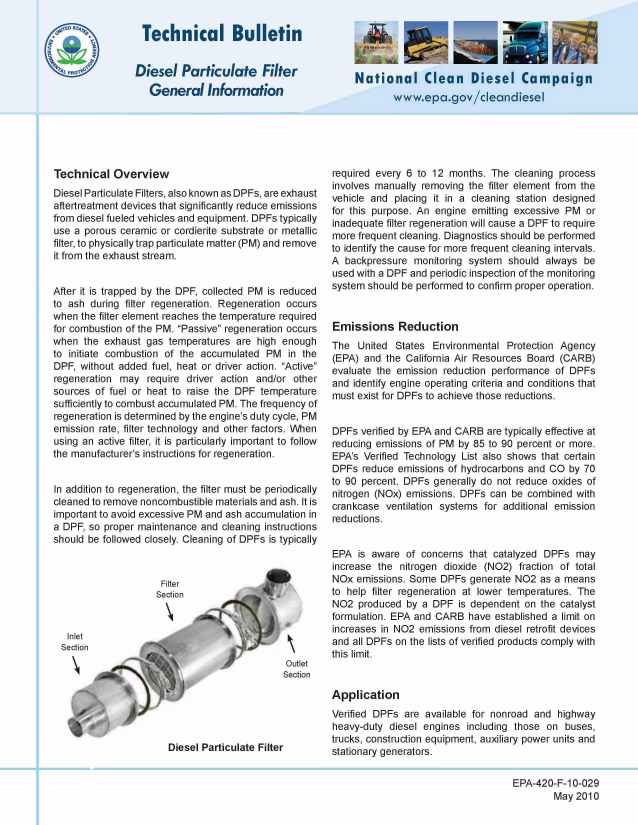
One of the most popular ways to make diesel cleaner is filtering the exhaust before it is released into the air. A common type of filter are cordierite wall flow filters which you see in this image. They are very efficient and relatively inexpensive. These filters remove particles of size 100 nano meters and up.
The ones approved by the Environmental Protection Agency in the USA filter at least 85 percent of particulates, though some filter percentages in the upper 90s. When the filter is “full” it gets burned by the engine itself. Remember that most of the particulates gets created by incomplete combustion in the first place, so you can in principle burn them again.
However, a consequence of this is some of the particulates simply get too small to be caught in the filter and they eventually escape. Another downside is that some filters result in an increase of nitrogen oxide emission when the filter is burned. Still, the filters do take out a significant fraction of the particulates.
Another measure to reduce pollution is exhaust gas recirculation. This isn’t only used in diesel cars but also in gasoline cars and it works by recirculating a portion of the exhaust gas back to the engine cylinders. This dilutes the oxygen in the incoming air stream and brings down the peak temperature. Since nitrogen oxides are mostly produced at higher temperature, this has the effect of reducing their fraction in the exhaust. But this recirculation has the downside that with the drop of combustion temperature the car drives less efficiently.
These technologies have been around for decades, but since emission regulations have become more stringent, carmakers have pushed their development and integration forward. This worked so well that in 2017 an international team of researchers published a paper in Science magazine in which they claimed that modern gasoline produces more carbonaceous particulate matter than modern filter-equipped diesel cars.
What’s carbonaceous? That’s particles which contain carbon, and those make up about 50 percent of the particulates in the emissions. So not all of it but a decent fraction. In the paper they argue that whether gasoline or diesel cars are more polluting depends on what pollutant you look at, the age of the engine and whether it carries a filter or a catalytic converter.
I think what we learn from this is that being strict about environmental requirements and regulations seems to work out pretty well for diesel emissions, and the industry has proved capable of putting their engineers at work and finding solutions. Not all is good, but it’s getting better.
And this has all been very interesting but hasn’t really helped me make up my mind about what car to buy. So what should I do? Let me know what you think in the comments.
Jim
2022-05-09 02:14:17 +0000 UTCWalt Donovan
2022-05-08 21:39:46 +0000 UTC