SakeTami
American Exception
American Exception

patreon


Episode 74: Dark Power and the American State (EDS Part 11)

In this episode, we wrap up our social science exploration of imperial criminality.

We discuss dark power—i.e., top-down or despotic political power. Dark power is to be contrasted with open or democratic power—power derived from consensus and persuasion.

This is the 11th installment of our Empire and the Deep State series--an in-depth exploration on my new book American Exception: Empire and the Deep State. I am again joined by series co-host Ben Norton of Multipolarista as well our own Seamus McGuinness who is producing the series.

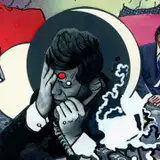
Special thanks to Seamus for the episode art and Dana Chavarria for the sound engineering!

Music: "Too Good Your Dreams Don't Come True" by Mock Orange

Episode 74: Dark Power and the American State (EDS Part 11)

Comments

I think its a reference to a potential agency that is more secretive that the CIA, and with likely even more overriding power...but we don't know if there even is such an agency, much less what its name is.

Aaron Good

Is the unnamed agency Peter was alluding to related to tasks force 157 by any chance?

Himbo Slice

Sounds like the US Supreme Court has been dismantling the protections against price fixing, it even has a nicer name: “price maintenance.” https://www.alston.com/-/media/files/insights/publications/2007/07/iantitrust-advisoryi-supreme-court-holds-resale-pr/files/leegin-advisory/fileattachment/leegin-advisory.pdf

Louis Waweru

Thanks! The series is about to take something of a turn as we get into the history of the US deep state. I think the dissertation/book is really two books: one on theory designed to correct the failure of US social scientists to deal with antidemocratic imperial criminality and a second on the actual history of the US deep state considered in light of the foregoing theory. This second half is more engaging in my estimation. It starts with the next episode in the series which also has great artwork.

Aaron Good

Guys you are absolutely hitting it out of the park with this unbelievable series. I listen to you while doing the dishes, the vacuuming and still have enough left over for a long walk. Scales are falling from my eyes. Peace, love and respect from your 5-eyes (but not AUKUS) partner Aotearoa / New Zealand.

Tim Hayward

The more exposure I get to this polisci/IR theory, the more I think it should be part of the core curriculum in a public education. Then I realize this would bring down the empire, and makes me wonder if any society can be stable or able to act sovereignly if the population is aware enough to not need to be propagandized. I can see the pragmatic argument for the necessity of these systems, but I hope there’s been thought given to how we can overcome the need for such a disappointing framework. Are the theorist working towards something like this? Is the idea that this should be a goal in the academy? I would imagine federal grants aren’t funding this type of research.

Louis Waweru

Maybe and maybe not. At any rate the people who rallied around these labels first applied those terms to distinguish themselves. As far as Neoconservatives, go, prominent among them in the late 1960s were foreign policy hardliners Norman Podhoretz and Irving Kristol (the author of a book entitled "The Neoconservative Persuasion) both associated with Commentary magazine. Neoliberalism is more complicated, because the word "liberal" here doesn't have its familiar Anglo-American political connotation of rule of law and primacy of human rights, but rather, "liberal" as used in Europe and Latin America, as a term referring to Laissez-faire economics: the "free market". (This is sort of a horrible simplification). "Neoliberalism was coined group of right-wing Austrian economists who got together in in 1938 at a conference in Paris to honor pundit Walter Lippmann (a critic at that time of the New Deal -- he subsequently had a nervous breakdown) and then in the early fifties Milton Friedman used it to describe his own laissez-faire economic philosophy. Recently, in the face of mounting criticisms and policy failures, a lot of neoliberals have begun to deny they had ever been neo-liberals or that any such thing had ever existed.

Ellen Harold

This series is the best! This may be Part 11, but I’m sure there are others like me that are hungry for so much more

pod accoster

I don't really like all these "neo" terms, like neoliberal and neoconservative. Is there anything really all that new about them?

Cultus Daemon

Achnacarry agreement https://www.scotsman.com/business/new-book-traces-story-secretive-highlands-oil-agreement-1434003

Jon Croteau

I graduated from college almost 10 years ago, and this series is the best political science course I’ve ever taken.

Brendan Garcia


More Creators