A Thousand Year Voyage- Chapter 26
Added 2025-07-25 14:36:25 +0000 UTCTragoth swung the Giant Crusher in a wide arc. The hammer, monstrous and almost as large as he was, moved like a force of nature in his grip—inevitable and final.
The first to meet its wrath was the priest.
Brother Elbert, though Tragoth would never learn his name, led the charge with a scream full of righteousness on his lips. He was clothed in a plain robe of his faith, though there was a gleaming breastplate on his chest, the emblem of the Seven painted proudly on it. The light of the torches caught in his blade as he raised it high, invoking the Warrior as he closed.
He didn’t manage to reach Tragoth, as the Giant Crusher met him mid-step, the enormous hammer striking the priest square in the chest.
The sight that followed was hideous—bones caved inward, armor folded like paper, a burst of crimson exploded from his back. The man’s body burst under the force of the blow, mangled chunks of flesh and twisted metal thrown into the air, raining down on the grass, the road and the oncoming wave behind him in equal measure.
But despite the gruesome sight, the mob didn’t stop.
Driven by either zeal or pure adrenaline, they surged forward, the men swinging their weapons and howling like beasts. More than a hundred came at Tragoth, faces drawn in lines of both fear and hate, the flock rushing at the armored warrior while clutching swords, axes, pitchforks, knives and hammers—anything that could cut or stab or bludgeon.
As they ran, Tragoth stood firm.
As they arrived, Tragoth moved.
The Giant Crusher swept sideways in a great arc, low and wide, connecting with the approaching flesh and bone like a thunderclap. The front row of attackers—six, maybe seven—were torn from the ground and hurled like sacks of meat, their bodies twisting in the air before slamming into the earth with audible cracks, men dead even before they landed.
Another swing, this one from below, and one man was flung high enough to disappear from sight, only to come down seconds later in a limp heap and crush another.
Yet another man lunged toward the hammer, hoping to catch the haft, to stop its terrible dance—but Tragoth twisted and yanked the man holding his weapon from the ground, dragging him behind it like a sack of flour and hurling him into the nearby boulder with a crack that broke both bone and rock.
Then, using the momentum from the previous motion, Tragoth turned and brought the hammer down overhead onto a cluster of attackers—three men vanished under the weight of it, crushed into wet pulp. The impact of the powerful blow sent fragments of stone and flesh in every direction, catching others and cutting them down as if by shrapnel.
Some of the attackers managed to get too close for Tragoth to use his hammer against them freely, but it didn’t change their fate.
Moving faster than his frame would have suggested, Tragoth threw his hammer at one of the men in the back, crushing him, and began to use his gauntleted fists against the mob surrounding him. One punch caved a man’s face inward, shattering jaw and nose and sending teeth scattering across the dirt. Another struck a man in the ribs and left him writhing in agony, every bone in his side snapped. A third, unlucky enough to try and grapple him, was lifted bodily into the air, then smashed down headfirst onto another assailant—skulls cracked like gourds, their blood and flesh mingling in the dirt.
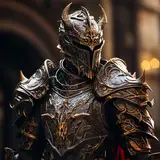
A particularly bold attacker managed to leap onto Tragoth’s back, trembling hand groping for his visor, blade poised to plunge. Tragoth answered by snapping his head back—his helmeted skull crashing into the man’s face with a crunch that turned the bone structure of the man’s head to pulp. Without pause, he brought his head forward again, ramming the curved horn of his Bull-Goat helm into the next man’s face—so deep the tip punched out the back of his skull.
After that, more came—perhaps thinking Tragoth had begun to tire, perhaps pushed forward by momentum or the misplaced bravery—and more fell. They came in ragged waves, clinging to whatever shreds of purpose they had left, and were broken like driftwood against a cliff.
The sounds of battle—shouts, screams, the thunderous impact of metal meeting flesh—began to dwindle. One by one, the voices faded. The clang of weapons dulled. The silence returned.
And after a while, the mob finally cracked.
The brave and foolish had met their end.
The cowardly and foolish broke and scattered—some fled stumbling over corpses of their comrades, some limped away with shattered bones, some crawled through mud and blood with no destination in mind but away.
Only a handful remained, frozen in place as if turned to stone, either paralyzed by horror or too deep in their delusion to recognize death drawing close.
Tragoth stood still in the center of it all—a lone figure amid the mayhem. Around him, the ground became a tapestry of colors, one painted by mangled bodies, broken weapons and blood-soaked earth. His breath came easy, deep and steady, the pleasant thrum of battle still echoing through his veins. There was no trembling in his arms, no fatigue in his body, only calm satisfaction from a job well done.
The Giant Crusher rested beside him, its massive head dripping with gore it had gathered in the course of battle. Chunks of meat that clung to it were steaming lightly, the flesh baked by the heat created with every swing. At this moment the hammer looked less like a weapon and more like a monument of the battle just fought.
The armored warrior exhaled softly, surveying the effects of his work, then he allowed himself the smallest smile beneath his helm.
The attackers had been subpar—untrained farmers and workers with no experience in combat—but they had come in numbers, and that at least had been enough to rouse his limbs, to stretch his muscles, to remind his body of what it once was forged to do.
It had been… pleasant.
"A fine stretch." Tragoth declared to no one in particular, rotating his shoulder until it popped. "I could’ve used more variation in your attacks, but I think you did surprisingly well considering the circumstances.”
He stepped forward, boots squelching in the blood-soaked soil. He was ready to end it, to offer the dignity he could provide—clean deaths to valiant if misguided opponents that still stood before him—but then, he saw it.
A flicker—brief and orange—at the edge of his vision.
As Tragoth turned his head toward the village, he saw fire.Bright tongues of flame licked at the sky, dancing atop rooftops that were never meant to endure heat.
The blaze hadn’t consumed much—most of the settlement had been built from enchanted stone and reinforced metals, their surfaces too resilient to catch fire without concentrated magic or intense temperature. But here and there, flames had found purchase—homes crafted from hay and timber, created from those materials to provide comfort and charm to their owners, became easy targets, the buildings falling prey to torches and sparks.
Smoke curled upward in thick, serpentine ribbons, twisting into the moonlight, while the wind was carrying distant voices—high-pitched and frenzied, belonging to the attackers judging by the sound.
Tragoth’s expression didn’t change beneath the horned helm, but inwardly, he scowled.
He should’ve anticipated this. He should’ve known that the attackers would split and attack the village from the side while he entertained their front line.
He turned his gaze back to the survivors—the five who still remained, trembling and smeared with the blood of others. They were huddled together in a broken wedge, shoulders pressed close, as if the touch of another might delay death’s approach. Their faces were pale with horror, yet in their eyes, he caught it: a glint of something close to hope.
As if the flames meant something. As if fire made what they had done worthwhile.
The warrior bent down, wrapped his gauntlet around the haft of the Giant Crusher, and lifted it slowly from the earth. The weapon rose like a beast waking from slumber, its massive head slick with congealing blood.
He straightened, towering over the remaining survivors, the moon casting his shadow across their quivering forms.
“Well then,” he said, voice low and steady. “My courageous opponents.”
They flinched at the sound.
“I don’t know if I should commend your ingenuity…” he continued, stepping forward, stone cracking beneath his plated boots, “…or damn you for dragging all those poor souls into something that should’ve ended right here, between you and me.”
With a sudden burst of motion, Tragoth lunged, feet slamming into the ground with enough force to leave impressions. With the grace of a charging bull, he leapt forward and swung the Giant Crusher in a wide arc.
Five bodies ceased to exist as men. They were reduced to matter—torn apart in a burst of bone, blood, and flesh. What was left of them hit the ground in wet chunks, scattered like meat from a butcher’s table, staining the grass in red.
Tragoth exhaled, then turned towards the village, as he knew he would be needed there.
After all, when the villagers woke from the slumber they had fought so hard to earn, they would not know when to stop and someone would need to be there to remind them.
Tragoth began to walk, the hammer resting against his shoulder.
***
Unaware of the one-sided massacre that was about to unfold at the main gate, another group of the faithful—led by Brother Lucifer—waited with bated breath along the eastern wall of the village. They crouched in silence, the full moon casting silver across their nervous forms.
Their numbers mirrored the frontal assault, though the quality of their arms did not. Given that they were not the ones to meet the inbetweener guards upfront, the men were mostly unarmored, draped in simple clothes, members of the group clutching small blades and farming tools honed into crude weapons. Each attacker carried a torch unlit, bundled at their waist or clutched in shaking fingers, awaiting the right moment to ignite them.
Crude ladders—cobbled from barnwood and bound with rope—had been hauled by hand, bundled and dragged across the terrain like siege instruments. The wall before them was tall, as tall as two men, so they needed the ladder to quickly climb it without being seen.
Eventually, a signal came - one in the form of distant screams coming from the gate, assumed to have been made by the panicked inbetweeners.
The group moved swiftly, hunched silhouettes rushing through the tall grass beneath the pale light of the moon. Ladders were hauled into place, wood scraping against stone and dirt as they were hoisted upright, Brother Lucifer barking quiet orders as the faithful ascended the wall and dropped over the other side, into the shadows of the village’s edge.
They moved in silence, lighting their torches in preparation for what was to come. Within seconds, flames flickered to life, licking at the air.
And after more than a half of the faithful breached the walls, they found themselves ready. They scattered in every directions— some moving alone and some in groups— with their torches raised, their weapons drawn and their hearts full of righteous fury.
The faithful surged into the village proper, ready to spread chaos and bring death to any monster they could find, but what they found was… not what they had expected. The village they found themselves in was not the ramshackle settlement they expected. There was no crude sprawl of tents and hovels, no lairs and caves containing their dangerous beasts.
No, what they found was functionally a foreign town, one seemingly more advanced than even Oldtown itself.
The buildings were mostly made of stone— one that was pale and mortared with impossible precision, their angles too perfect and their surfaces too smooth. The roads were straight and clean, paved with interlocking tiles. Blue lanterns placed at the sides of those roads, cast a gentle, blue glow that gave the place an otherworldly ambience. Various alien contraptions and tools could be found in the village, their use incomprehensible to the faithful.
The animals they saw were no less disturbing. Pens and enclosures lined the outer roads, filled with beasts no member of the Seven had blessed. Some were the size of dogs, but shaped like the nightmarish offspring of spider and scorpion, their visage horrible enough to cause the faithful to step back in shock. Even more offensive were the sheep—if they could still be called that—that rolled like barrels, the animals clearly warped by the blasphemous magics of the inbetweeners.
In any other circumstance, the sights they had seen would mesmerize them. Tonight, they only made them more furious, as the stone structures and alien sights made it harder for them to find a proper foothold for flames.
Still, chaos inevitably found a way.
Some houses—built in a simpler, seemingly more sentimental style—were made of wood and hay. These caught fire readily, and when they did, cheers rose. Paintings, sculptures, and intricate crafts left outside homes—idle expressions of immortal boredom—were stomped and shattered, their remains set ablaze with triumphant glee.
The destruction came in small patches, not large waves, but that didn’t matter. The true horror would come not from the flames—but from the violence they would bring upon the abominations.
With grim smiles, they began their grim task.
Some stood near burning houses, blades ready, breath held in anticipation of the first frightened wretch to flee.
Others broke into the buildings they couldn’t set on fire, howling prayers to the Seven, eager to strike down whatever heresy lay within.
A handful of the faithful even veered toward the animal enclosures, hacking at locks and slashing at the strange beasts, determined to rid the world of every unnatural form.
But in the end, nothing went according to plan.
Those who had sought easy slaughter among the animals kept in enclosures found death waiting in forms they couldn’t predict.
What the inbetweeners considered livestock, the Westerosi attackers discovered were not passive creatures normally to be found on a field, but remnants of the world much harsher than their own.
A man tried to spear what he thought was a docile (if rolling) sheep, only to be slammed bodily into a wall by its rolling, sparking bulk.
Another burst into the spider-scorpion enclosure and plunged his pitchfork at the nearest one, only to find the chitinous shell to be staggeringly durable. He couldn’t even blink before the enormous insects swarmed him, their deadly venom keeping him immobile while they dragged him to their young.
The unlucky one met a land octopus, kept at the beach next to the village’s small bay. When he got close enough to prod the bulbous creatures with his blade, the tentacles gripped his ankles, neck and mouth, helpless man brought to the beast’s beaked mouth to be devoured.
Ironically, the only creatures the faithful could have bested—guillemots—were left untouched. Their dark plumage hid them in shadow, and none of the torchbearers had time to look down to closely.
And yet, for all the horror wrought by the livestock, none of it compared to what came next.
Because then… the villagers came out.
The attackers had imagined an easy victory. They expected monsters, yes—but monsters cowering in their homes, caught off guard, confused by flame and steel. They envisioned a slaughter—swift, righteous, a purge of blasphemous filth.
What they got instead were broken souls wrenched from a blissful slumber—not warriors by trade, but survivors worn thin by the millennia of violence, now forced to remember what it meant to kill.
The inbetweeners who remained in the village had not been the strongest, nor the bravest, nor the most ambitious. They were the ones who had no strength left to endure more, the ones too tired to keep marching, the ones who had given everything and asked only for quiet.
They emerged from doorways and collapsed rooftops in silence—their movements slow and haunted. Some carried weapons dulled by time and crusted in dust. Others bore nothing but their fists and claws, their natural weapons clenched for the first time in centuries. Some wore mismatched armor. Others wore nothing. They came with glowing eyes, fractured horns, gnarled hands, skin marred by scars.
And they charged—ain scattered packs, in singles and pairs, howling or laughing or weeping or silent. Some sprinted like beasts. Others stumbled, legs stiff with disuse.
They fought like they had lived: badly, painfully, but with the desperation of those who refused to die again and strength that couldn’t be stopped by the ones who came to their village.
Limbs were torn from sockets. Heads twisted, bones popped. One man screamed as his body was folded in half, spine cracking like a snapped bowstring. Another was buried under a group of inbetweeners, his shrieks muffled as their claws tore into him like dogs fighting over meat.
The slaughter was not clean. It was not elegant.
It was feral. Brutal. Drenched in desperation.
Because these people weren’t warriors. They were people who had once lived in a world that required violence just to survive a day.
They were people who did not want to kill—but they didn’t remember how to stop.
Of all the things that happened that night, the most tragic were the memories that had to be revived and the hands that had to remember how to kill.
***
Then again, perhaps more tragic than the hands forced to remember how to kill… were the ones that had to learn.
Like Roderika’s.
The girl, because that’s who she still was despite the long centuries, had never been a warrior. When the other tarnished fought and died, she simply watched—first uselessly, then while providing her services as a spirit-tuner. Though her role in Hadwyn’s journey had been important, she had often been forgotten in the tales—overshadowed by the strong and the brave.
And yet she was to be quite pivotal to the tale that unfolded, if only because one of the homes that caught flame that night was hers.
A most tragic event—for it was not the first time fire had chased them from a place of safety. The Roundtable Hold had once burned just the same, gone down in roaring flame.
But while Roderika simply remembered that night with a quiet, sorrowful ache in her heart, Hewg seemed to draw something else from the flames.
The old smith, so long adrift in a fog of forgotten memories and lingering duty, stood in the heart of the blaze with new strength in his limbs. The fire had brought him back, at least in part, to his old forge, the one in the Roundtable Hold—where he forged a god-slaying weapon and fulfilled his purpose.
And as Hewg was lost in his memories, it fell to her to save him.
Roderika pleaded, pulled and pushed, urging Hewg to go with her, but the misbegotten smith resisted, intent to forge the weapons until the entire building collapsed. Still, she didn’t let go. She slowly forced him toward the entrance, step by step. And though it took time and strength she barely had, Roderika finally pulled him into the night, staggering out into the cold air.
Only then she found out that outside was worse.
There, waiting just beyond the door, stood a ring of strangers. Men with torchlights in hands, weapons drawn and symbols of the local faith on their bodies. Their eyes locked onto her, not with concern—but with hate.
And maybe, if she’d been alone, she would have done what she always did—ran away. Hid. Possibly summoned a spirit or two to cover her and wait for danger to pass.
That was her way. That had always been her way.
But she wasn’t alone.
She was with Hewg.
The one who had taken her in when she was fragile and afraid. The one who had taught her how to attune to the spirits. The one who had provided her with warmth she desperately needed despite him himself never receiving any from the world.
And Hewg—hunched and grey, misbegotten in his nature—seemed to fuel their anger more than she ever could. The men were looking at him like he was a symbol of everything wrong with the world.
And so they ran toward him with drawn swords and screams on their lips, no warning or explanation, as if killing him would cleanse something inside them.
And that… she could not allow.
In that moment, Roderika found her strength.
With a motion almost too fast to follow, she reached into the folds of her robe and drew forth two bells, small and silver.
She rang them and the world changed.
From the sundered veil between realms, two titanic forms clawed their way into the world of the living. Translucent and shrouded in blue light, the trolls loomed—each the height of a house, spectral muscles rippling beneath shimmering blue skin, their monstrous heads hidden behind helms. In their hands they held iron swords so massive they looked more like pillars than weapons.
The attackers had no time to scream.
One was flattened instantly, his body compressed into gore beneath a single downward swing. Another was seized by one massive fist and hurled into the sky with such force that he vanished into the swirling smoke above, his fate sealed before he ever hit the ground.
The rest turned to flee. But the trolls were already moving. With impossible speed, the summoned giants carved through the fleeing men like scythes through wheat. Voiceless roars shook the air, a deep, thunderous sound that reverberated through stone and flesh alike.
And Roderika stood between it all—unmoving, eyes wide with horror and fury and something else she didn’t yet understand.
She looked around, only to see several houses burning, the attackers dying in swathes and her neighbours—people she had tended to, shared meals with, comforted in quiet moments—now lost in a frenzy of blood, wailing and snarling. She then looked to Hewg, who stared longingly into the fire, muttering things about perfect heat, not understanding that his forge was collapsing in front of him.
And so began Roderika’s first battle.
It would not be remembered in song, but it was somehow more meaningful than most.
She raised her arms, bells still in hand, and rang them again.
And again.
And again.
She rang until the night filled with specters.
The spirits spilled out in waves—spirits bound by sorrow and duty, each different from the last. There were knights with no heads. Wolves whose howls carried no sound. Sorcerers with masks of stone and wands in hands. Hulking demi-humans. Towering monks. Hooded assassins. And more. So many more.
Some surged through the village like a spectral tide, hunting the remaining attackers—those still not killed by the living. They fell on the fleeing with merciless efficiency, cutting down anyone who dared to run or hide, the translucent bodies deaf to the cries of mercy.
Others turned to the flames—massive trolls and masked sorcerers working in eerie unison, smothering fire with spells or simply large hands. Flames subdued under their efforts, shrieking futilely before being snuffed into smoke.
Some spirits brought no violence—they glided quietly through the streets, touching the shoulders of weeping inbetweeners, guiding them back to their homes with spectral hands. They comforted, wordlessly and gently, the villagers sadly finding the dead safer than the living.
The rest of the spirits already began to gather corpses— piling the corpses of the attackers into a single, growing mound. What to do with them, no one yet knew.
And by dawn, the village stood, the only evidence of the attack being ash in the air, the pile of corpses and the hollow eyes of the villagers.
In the end, much was lost and not much was gained.
And Roderika?
She had found her strength, though the price was heavy.
And what would come of it… only time would tell.
***
Contrary to the eventful night the village experienced, the chaos that engulfed the inbetweener village, the flock’s march toward the Perfume Quarter ended rather…anticlimactically.
The priests who had planned the attack, despite their otherwise delusional attitude, were surprisingly correct in their assessments when it came to the Perfume Quarter: it was a home to the members of the merchant clan—at least those who preferred the fixed rhythms of trade in Oldtown to travelling with Hadwyn or sailing on the Wisdom of the Moon.
They were right, too, in believing that these merchants were not warriors, their direct strength subpar compared to many of the inbetweeners. They also correctly guessed that they were surrounded by flammable goods and volatile substances of unknown origin, ones that could burst into flame from a smallest ember.
From a tactical standpoint, it was the ideal place to strike.
Had they entered, the assault would have seemed like a triumph at first. Torches would take to the tents and awnings, the fabrics igniting and erupting in flashes of heat. The strange mules the merchants favored would bray in confusion and fall easily to steel. For a time, the Perfume Quarter would be overwhelmed.
There would be some casualties, though not from any active resistance. Here and there, the Faithful would wander too close to an inconspicuous crate or jar they shouldn’t have touched, only to die in a fiery explosion or from a particularly deadly poison. Their deaths would be seen as unfortunate mishaps, worthy of an awkward prayer and a shrug, but nothing serious enough to stop the momentum.
The merchants would not fight back, at least not initially. They would flee, retreat, scatter down alleys and duck into small passages. They would plead as they ran, their cries panicked and trembling:
“Why are you doing this?”
“We’ve hurt no one!”
“Please, not again…”
But the flock would not stop- their blood was up and their path divinely sanctioned. They would chase the merchants to the walls, crowding them against stone.
Blades would rise. Final pleas would be ignored.
And then… everything would go wrong.
The merchants, backs pressed to the walls, their hands trembling at their sides, would begin to scream—not with terror, but with despair. Their voices would crack, hoarse and broken, as if something deep within them was fracturing beyond repair. Their fists would clutch their heads, as though trying to suppress something clawing up through their minds.
The mob would laugh. To them, the screams would be a sound of victory—a sweet chorus of prey finally cornered. They would see no threat, only weakness, and raise their weapons higher in anticipation.
The merchants would ask, their voices drenched in bitterness and bile, their question simple: “Why? Why did you make us do this?”
And then, their eyes would open wide and the light that spilled from within would not be meant for mortal sight.
It would be a glow sickly and pulsing, a yellow so wrong it could stain a soul. Madness made visible, ancient and alive.
From those eyes would burst rays of golden frenzy, searing beams that warped the air. Their mouths would fall open in unison, and chants would pour forth—atonal, garbled and layered. The ground beneath the attackers would split with tongues of yellow fire. Balls of warped flame would swirl and crash into the mob, devouring bodies and minds alike. Clouds of intoxicating blight would rise, clinging to lungs, to skin, to reason.
Some attackers would fall instantly, skulls bursting like overripe fruit, their minds shattered under the malevolent gaze. Others would burn alive, dancing in pain and joy until only ash remained.
Some would survive for a while—shaking, drooling, whispering words no tongue should know. Their minds would wander into mazes from which they’d never return.
The Perfume Quarter would stand, the merchants would remain and the mob would be purged.
But the price paid would be terrible indeed.
For something would stir. The Frenzied Flame—the spurned sibling of the Greater Will—would turn its gaze upon the world, currently so peaceful and tranquil. And it would not like what it saw.
That is what would have happened—had the flock reached the Perfume Quarter.
But for that very reason, it never did.
Hadwyn, and those he had entrusted to lead Oldtown’s inbetweeners in his absence, understood the burden the merchants carried—and the risk that would follow should they fall to protect them.
That’s why the Perfume Quarter was never left unguarded. It was the safest place in Oldtown that night, perhaps the safest place in all of Westeros—save for the side of Hadwyn and Ranni, or within the floating sanctuary of the Wisdom of the Moon.
The mob came just as they had elsewhere—torches held high, crude weapons gleaming, their hearts thrumming with rage and holy purpose. They moved as one, a wave of burning zeal and hatred, certain that this den of monsters would fall swiftly.
But they never even reached the gate.
Many eyes had been watching. Some placed long before by Hadwyn himself, others stationed more recently by Tragoth and Jolán, both of whom knew the importance of what they would protect. They had been warned of the assault, informed of the priests’ plans days in advance, and had prepared accordingly. Shadows nestled on the walls. They hid in the grass. They floated in the air.
And from within their cover, they saw the torches blobbing closer like fireflies drawn to a lantern.
As the attackers neared, a sudden wind swept down from the hills—a strange, biting gust far too forceful and well-timed to be natural. It tore through the ranks like an invisible wave, extinguishing the torches with a hiss, ripping flames from oil-soaked cloth, leaving the mob suddenly blind under the pale wash of moonlight.
And then came the arrows—fast, silent, and utterly merciless
From the heights of the walls, from the grassy hills, from high and from low, shafts streaked through the air, each one finding its mark. In seconds, men began to fall—some with soft grunts, others with startled cries—each heartbeat punctuated by the dull, wet thud of a body hitting the ground.
And before the confusion could even start to bloom into full panic, before the flock could even comprehend the trap they had walked into—came the shadows.
They moved with fluid grace, their movements silent and deadly like poisonous mist.
Unseen hunters stalked through the darkness and fell upon the faithful without sound or warning. They snatched men from behind, from the flanks, from the center and from the front—the victims pulled from the group one by one, vanishing into the darkness never to be seen again.
The faithful, once so eager of the hunt, turned into prey—meat to be hunted and harvested.
They scattered, tried to flee, to hide, to beg, to fight—but none of it mattered, for it was not a battle.
It was a culling.
The slaughter was surgical—quick, cold and impersonal—the attackers were picked apart with mechanical precision, their deaths fast and without ceremony. There was no resistance. No opportunity to beg. No face of their executioner to curse.
And in the end, there was nothing left of the attacking force, the only proof of their demise being a blood that had already started to soak into the earth.
As for the merchants?
Not a single one was disturbed that night. They slept soundly, or brewed late into the night, unaware of the massacre that took place.
They only learned of the local faith’s failed attempt to kill the inbetweeners the next day, when news reached them from the other settlements—and even then, they never learned that they were a target as well.
***
As he darted through the narrow alleys of Oldtown, feet skidding on uneven cobblestones and wings scraping against the walls, Berd began to suspect—rather strongly—that he might be in trouble.
It had all started innocently enough. The misbegotten had simply been enjoying a late-night walk, taking in the architecture of Oldtown with the quiet awe of someone fulfilling a lifelong dream after having to spend millennia watching the architectural wonders of the Lands Between from his shoddy, little cave.
It was one of the reasons why he stayed behind, while most of the inbetweeners moved ahead—he wanted to see every crook and cranny of Oldtown before moving on to see other cities. He didn’t want to rush things.
Only, it may have been a mistake, as suddenly he was greeted by the rapidly approaching group of armed men, who were pointing fingers at him and shouting obscenities.
At first, Berd had assumed that it had something to do with the fruits. Or the bread. Or any other treat he might have…discreetly grabbed from a stall while no one was looking. Perhaps it was related to the fact he would sometimes go into buildings he wasn’t exactly supposed to, to see what was inside.
But he was fairly certain no one had seen him. He was very careful to enter and leave unnoticed, after all.
Then, after he sucker punched the first few men who rushed him and found himself forced to escape as the increasing number of people began to chase him while shouting things about ‘monsters’ and ‘heresy’, he realized where that mob’s true motivations lay.
Yes, it was definitely a hunt for non-humans.
Very troubling, but also…oddly nostalgic? It’s been a while, after all.
And so began the pursuit.
Berd sighed through as he ducked into a side alley, his wings flapping uselessly behind him. They were too malformed for the extended flight—little more than twisted, leathery things that only let him make large leaps, but were useless among tight corridors and winding paths.
Oddly, it wasn’t hard to keep the distance at first, the misbegotten finding himself in a very unusual situation where he was the stronger one, but eventually the pursuers would start to catch up, more numerous and more familiar with the city.
Eventually, after a dozen frantic turns and a few strategically-placed kicks to people who got too close, Berd skidded around a corner—only to find five men already blocking the street ahead.
He turned, only to see five more cutting off his retreat.
“Oh,” Berd said, claws twitching. “Well that’s not ideal.”
He raised his hands slowly, not in surrender exactly, but in something resembling an attempt at diplomacy.
“Now, I don’t suppose we could all take a moment,” he said, flashing a grin full of jagged, uneven teeth, “breathe a bit, walk away, and agree to never speak of this again?”
The men didn’t answer. Their expressions were twisted, eyes alight with a blend of fear and disgust. No one lowered their weapon. No one laughed. One of his pursuers even spit on the ground.
Berd sighed, shoulders slumping. Yeah, of course it wouldn’t work.
Berd found himself faced with a choice, two equally risky options popping in his mind.
One: he could try to climb the building behind him—it wasn’t exactly the safest choice of action, especially given his lack of practice in vertical movement and the slight chance one of the pursuers would just stick a blade in his side or throw a rock at him mid-climb to make him fall into the loving embrace of the angry mob.
But before either bad idea could become reality, something quite unlikely happened.
A roar of flame erupted from the alley behind one group of attackers, a sudden wave of searing light and heat that surged forward and swallowed five of the men in a single breath. They began to scream—raw, awful howls as their bodies ignited. They twisted and fell, writhing and clawing at nothing.
The other five, the ones on the opposite side of the alley, froze for a heartbeat—then dropped their weapons and bolted into the dark, tripping over themselves in their hurry to escape, the men clearly not ready to face whatever caused this.
And so, Berd found himself alone in the alley.
No, not alone.
The flames dimmed, leaving behind a corridor lit only by the flickering glow of dying bodies—and from that glow, a figure emerged. She walked calmly, as if strolling through a garden rather than stepping over scorched corpses.
A woman, slender and tall, was probably beautiful by human standards, though Berd didn’t have enough experience in that area to be sure. She was wrapped in crimson from head to toe, her robes clinging to her like dancing fire. Her hair was deep red and spilled over her shoulders like a silk curtain, partially covered by a red hood on her head. Her skin was pale as alabaster and her eyes seemed to carry a fire on their own.
As she walked towards Berd, she looked at the smouldering bodies with certain fascination blended with unhealthy passion, the woman seemingly surprised by the effects of her work yet not dissatisfied in the slightest.
“Oh my…” she murmured, her voice soft and smoky. A small, thrilled smile touched her lips. “I only meant to distract them, perhaps scare them off. But this—this is a grand gift indeed. Is it a sign my attempt has been worthy of reward? That I reached the city this very night couldn’t be a coincidence, after all.”
Then, after she was done wondering, she turned her gaze to Berd. In her eyes, there was no fear or scorn, only curiosity and anticipation.
“… hi?” Berd offered, His claws fidgeting. He wasn’t exactly sure how to react—the woman certainly saved him, but it was never smart to interact with pyromancers too fond of their work. “Thanks for the, um... fiery help. Really. I very much appreciate it.”
The woman smiled.
“Please, don’t trouble yourself. I did only what was right.” She tilted her head slightly. “But… if you do feel a debt is owed, I wonder if you might indulge me with a small favor.”
“…sure, why not?” Berd replied, suspicion and gratitude battling in his mind. “What do you need?”
“I ask only for knowledge,” the woman said, a mysterious curve playing at the corner of her lips. “Tell me—who do you serve?”
Berd scratched behind one ear, tail twitching awkwardly. “Well, I mean… technically, I guess I serve Lord Hadwyn?”
It wasn’t exactly right, as Berd had never met the men nor cared to deeply about his plans and actions, but he supposed he was a servant of sorts, if only because he had some debt to pay for using the man’s boat.
“Hadwyn…” the woman whispered, the sound sultry and full of passion. Her eyes widened for a moment, something wild flickering behind them. She then smiled, a red hue flashing on her face. “So that’s the name he wears now,” she said softly, almost reverently. “Yes… yes, I would like to know more about him. After all…” Her voice lowered, almost to a purr. “He is my master as well.”
Something strange shimmered behind her eyes, as she said so, her smile deepening.