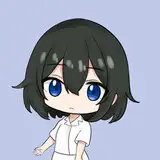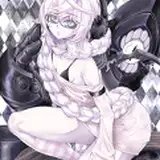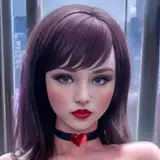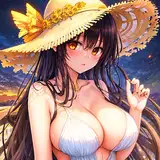
A wide variety of colors were used. However, most of them were distributed early on when I roughly blocked in colors with a large brush. I simplified forms such as the chest, hips, head, and torso into spheres or cylinders, rendering them so that the color transitions become soft.
As the brush size gets smaller, more detailed elements—like hair strands, ribs, and fingers—are rendered. At this stage, rather than introducing new colors, I mostly use the existing ones. Areas without fine details, like the chest or hips, will reach a point where there is nothing more to define with a small brush. That’s why it may be necessary to ensure smooth rendering with a large brush in the earlier stages.
Finally, I use a brush as thin as a needle to add even finer details. This is when I refine any areas that were not detailed enough in the previous stage and further define individual strands of hair. Tiny elements like the eyes and mouth can only be properly rendered at this stage.
The most important thing in this process is to believe in yourself. During the middle stages, the painting may look blurry or unsatisfying. But every time you feel that way, take pride in your progress and keep going!