We've got a new episode today for you. Also read on to get some details on the research behind the episode, as well as a campaign update. Cheers!
More About Cone Snails
Cone Snails have an arsenal of tools and weapons under their pretty shells. These reef-dwelling hunters nab their prey in microseconds, then slowly eat them alive.
There are hundreds of species of these normally slow-moving hunters found in oceans across the world. They take down fish, worms and other snails using a hollow, harpoon-like tooth that acts like a spear and a hypodermic needle. When they impale their prey, cone snails inject a chemical cocktail that subdues their meal and gives them time to dine at their leisure.
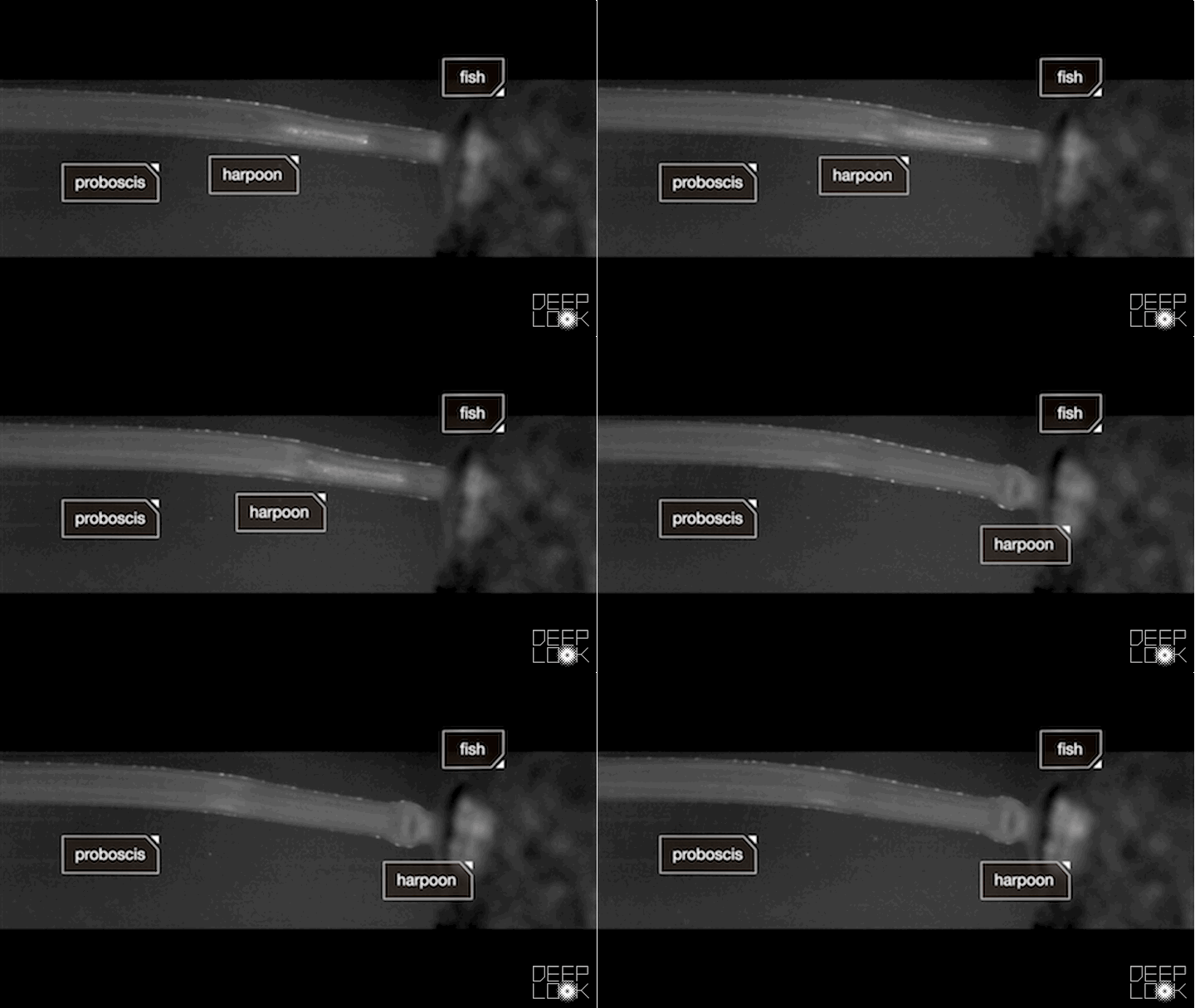
It’s the way they shoot the harpoons that amazes researchers. Cone snails launch their harpoons so quickly that scientists were previously unable to capture the movement on camera, making it impossible to calculate just how speedy these snails are. Now, using super-high-speed video, researchers have filmed the full flight of the harpoon for the first time.
It’s not quite as simple as pointing a camera at a snail, however.
Joseph Schulz, a biologist at Occidental College in Los Angeles, studies the biomechanics of how cone snails fire their harpoons, and led the efforts to document the phenomenon.
Schulz’s team used cat cones, a small, fish-hunting species of cone snail with shells about 1 to 2 inches long. Their hunting appendage — a fleshy, extendable tube called a proboscis — is translucent, like frosted glass. That allowed the scientists to view the harpoon, which rests within the proboscis, and film its movement.
To record the harpoon-firing process, the researchers had to train the cone snails to extend their proboscis down a heavily illuminated trough and shoot the harpoonlike tooth into a fish-scented membrane at the far end.
Optical micrograph of the barbed, hollow harpoon of Conus bandanus, a cone snail that lives in the Indian Ocean. (Courtesy Manuel Jimenez Tenorio, Universidad de Cádiz)
“It’s not like a movie of a hummingbird wingbeat,” Schulz said. “We had to pass enough light through the proboscis to highlight the tooth.”
The lighting was so bright that the scientists had to wear sunglasses during the experiments, he added.
The team started the high-speed filming using a recording speed of 8,000 frames per second. But it couldn’t match the speed of the cone snail strike. They had to bump the frame rate all the way up to 58,000 frames per second to fully capture the harpoon’s movement.
By comparison, slow-motion replays in baseball and football games are usually filmed at 500 frames per second, said Toni Lucatorto, a product manager with Vision Research, the company that manufactures the high-speed camera that Schulz and his colleagues use.
From start to finish, the harpoon’s flight takes less than 200 microseconds. That’s one five-thousandth of a second. It launches with an acceleration equivalent to a bullet fired from a pistol.
For those of you pledging $10 a month and above, you'll get early access to our videos the week before everyone else.
For all of y'all who give us $5 a month of support and up, don't miss our post later today with your exclusive digital downloads.

--
Campaign Update:
Wow - we are fast approaching the 100 patron mark! Not bad for the first 2 weeks. Thank you so much for your support!
If you have not joined yet, you are missing out a ton of patron-only benefits like show updates, behind-the-scenes pictures, polls, notes from the producers, and even opportunities to help us choose episodes. You’ll also get 4K wallpaper and other delightful digital downloads, like GIFs, music and 3-D models for upcoming shows and favorites from our archives.
Carlos Cabrera
2018-05-29 21:35:00 +0000 UTCDeep Look
2018-05-29 20:59:39 +0000 UTCCrescent
2018-05-29 19:49:01 +0000 UTC